
FOSTA
Weather-resistant structural steel is protected from corrosive attack by a weather-resistant barrier layer, the patina. Special alloying elements such as chromium, copper, nickel and phosphorus lead to the formation of …
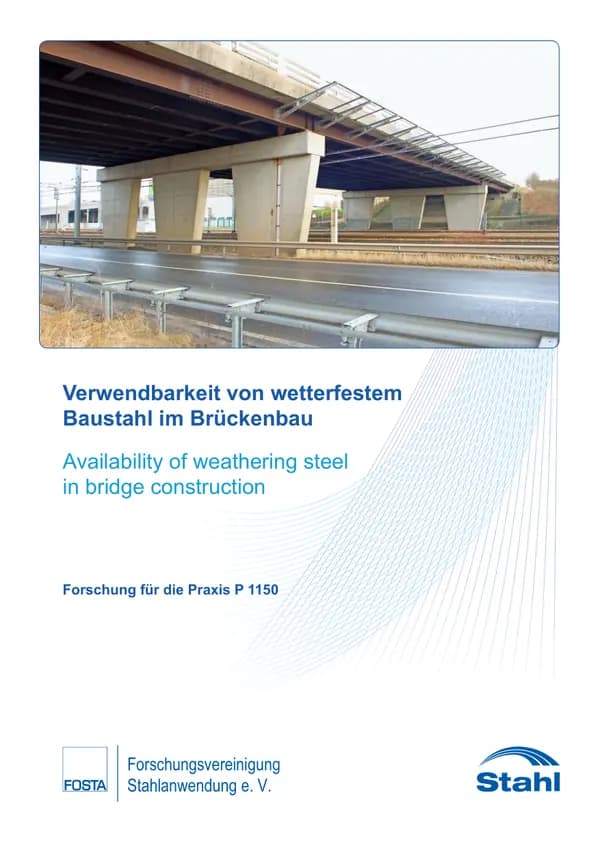
Weather-resistant structural steel is protected from corrosive attack by a weather-resistant barrier layer, the patina. Special alloying elements such as chromium, copper, nickel and phosphorus lead to the formation of the patina. The patina results in less corrosive erosion than with unalloyed structural steel, making an additional corrosion protection system superfluous. This leads to demonstrable economic and ecological benefits for structures used over the long term, such as bridges. In addition, weathering-resistant structural steel has largely the same mechanical properties as unalloyed structural steels, which allows it to be used without restriction in accordance with Eurocode 3. However, in order to utilise these material advantages, a design adapted to the corrosion behaviour is required, which in the past has led to a limited use of weathering-resistant structural steel in bridge construction.
For this reason, the present FOSTA short study was carried out to investigate the corrosive behaviour, the build-up of the protective patina of the steel under current atmospheric conditions and the load-bearing capacity of this material in slip-resistant prestressed connections. The aim was to demonstrate the current efficiency of weathering-resistant structural steel for bridge construction. The results provide an initial statement on corrosion behaviour, which demonstrates the possible applications of weathering-resistant structural steel under current atmospheric conditions. It was also possible to show that it is advantageous to use pre-stressed, non-slip connections made of weathering-resistant structural steel that are weathered and without a non-slip coating. It has also been shown that the requirements for the load-bearing capacity of these connections are met despite weathering.
Machine-translated title and description. The document itself is in German.
Payment by card (Stripe) or invoice (DE, AT, CH). Download link by email: automatically after ordering by card, after order approval for invoice (valid for 30 days). Terms
Digital download
Other parts and editions as well as neighbouring documents of the same series.
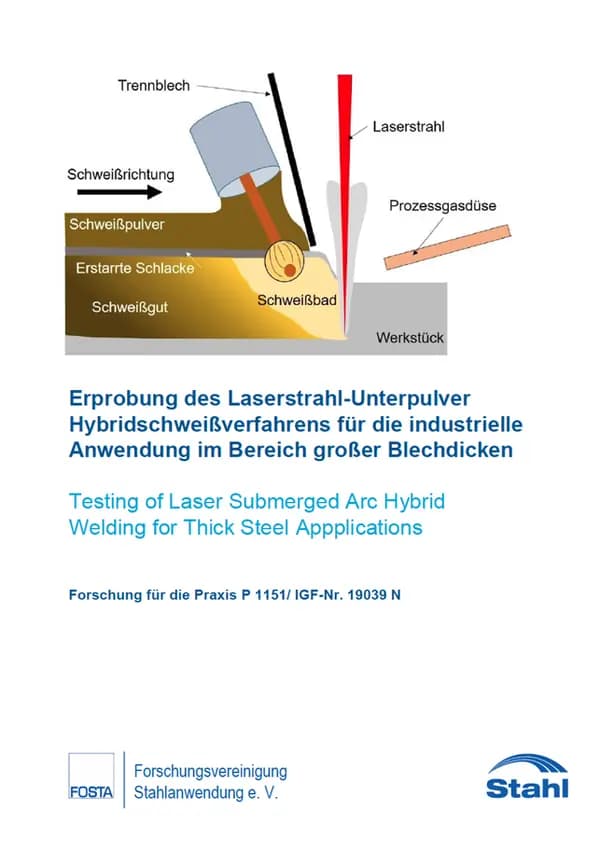
P 1151 - Testing of the laser beam submerged arc hybrid welding process for industrial applications in the area of large sheet thicknesses The previous series of tests on laser beam-submerged arc hybrid welding have clearly demonstrated the fundamental usability of the newly developed process variant. The weld seam qualities achieved in position-counterposition joint welds using both types of laser beam (CO2 and solid-state) are more than satisfactory within the scope of the investigations carried out. Sheet thicknesses of up to 50 mm could be reproducibly joined with low porosity. The aim of the current project was to optimise and homogenise the mechanical-technological characteristics of joint welds using the position-versus-position technique over the seam depth, based on the testing of suitable wire-powder combinations. A solid-state laser was used as the laser beam source, which provided a spot diameter of 0.4 mm with the applied optical components. In the same step, the increase in process stability against slag running into the laser foot spot was investigated by testing correspondingly tough and current-carrying welding flux variants. Furthermore, in addition to a sensor system for recording and automatically controlling the laser beam-induced welding depth, a sensor system for detecting precipitating submerged arc welding powder and advancing slag/melt was determined and tested. Publication: May 2020 Authors: Professor Dr Ing. U. Reisgen, Dr.-Ing. S. Olschok, O. Engels M.Sc.
available anytime
€30.00
excl. VAT
P 1152 - Approach for the numerical determination of hardness evolution in the mould surface layer due to thermal loads during mould hardening Tailored tempering, based on mould hardening, is a process for the production of components with tailored properties. By using partially preheated tools (approx. 500 °C), the critical cooling rate of the 22MnB5 blank material is deliberately undercut locally, thereby suppressing martensite formation in the component. The increased tool temperature and the press forces that occur lead to a high thermal load on the tool engraving and ultimately to signs of wear, which are dependent on the hardness evolution and tempering effects that occur. This affects the dimensional accuracy of the components and the tools have to be reworked or even replaced, which is costly and time-consuming. More precise knowledge of the processes in the tool surface and their consideration in the numerical process design contribute to a significant increase in process understanding. In this context, the heat transfer between the workpiece and the tool is another important aspect that is required to calculate the prevailing surface temperatures of the tool. Precise calculation of the surface temperatures allows changes in properties such as decreases in hardness due to tempering effects in the tool surface layer to be predicted, which are important for estimating the service life of the tool as a whole. By knowing the influences on the wear properties of the tool materials, measures can be taken to realise significant cost savings for SMEs. The scope for costly tool repairs can be reduced and tool life improved. The aim of the research project is to consider the hardness evolution of the tool material as a function of the number of thermal cycles in the wear calculation and thus increase the quality of the results of the simulative prediction. For this purpose, the hardness development was determined metallographically using the determined temperature curves in the tool surface during a model test. Based on this data, an analytical approach was developed and implemented in a commercial FE programme that enables the local tool hardness to be calculated as a function of the forming cycles and the existing tool temperature. Finally, a validation was carried out as part of a self-designed and constructed model test for the production of components with locally controlled hardness distribution. With the implementation developed in the project, the decrease in hardness in the tool could be predicted realistically, thus achieving the objective of the research project. Publication: 2021 Authors: Prof. Dr.-Ing. B.-A. Behrens
available anytime
€30.00
excl. VAT
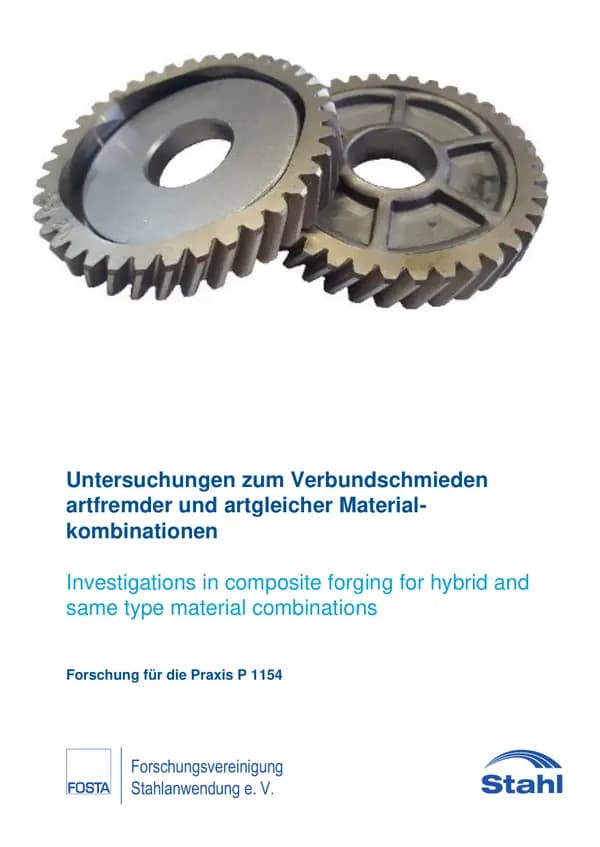
P 1154 - Investigations into the composite forging of dissimilar and similar material combinations s an element of the research network for solid lightweight construction, two hybrid wheel hubs were produced from a steel-aluminium and a combination of different steels by means of composite forging in sub-project 6 "Composite forging of different dissimilar and similar material combinations". The central question here is to what extent two materials can be simultaneously formed and joined to form hybrid components through the use of compound forging in order to utilise material-specific advantages for purposes such as lightweight construction or performance enhancement. To this end, a design for the hybrid components was developed at the beginning of the project with the project support committee and a joining strategy consisting of localised material and force locking was devised. In the subsequent numerical investigations, optimal semi-finished product geometries for composite forging, the implementation of the bonding strategy and a suitable process window within hot and warm forging for the dissimilar and similar material combination were determined. In the course of the experiments, the hybrid wheel hubs and, for later reference tests, wheel hubs in a simple material design were successfully produced. were successfully produced. In the further metallographic analyses, no force-fit or material-fit connection could be determined due to the scaling of the semi-finished products during the transfer times into the tool system. In contrast, EDX analyses and microhardness measurements revealed a material bond in the material combination of the same type. In the final tests, the mechanical properties of the steel-steel wheel hub were analysed using mechanical tests and the steel-steel and mono wheel hub were compared technologically. The composite forging approach was successfully utilised to use higher-strength material in highly stressed areas and an increase in performance was recorded. Publication: February 2020 Companies involved: A. + E. Keller GmbH & Co. KG, ArcelorMittal Hochfeld GmbH, BAUBLIES AG, CARL BECHEM GmbH, Cotarko GmbH, Daimler AG, ECOROLL AG, EZM Edelstahlzieherei Mark GmbH, fischerwerke GmbH & Co. KG, Georgsmarienhütte GmbH, GKN Driveline Trier GmbH, HAMMERWERK FRIDINGEN GmbH, Hirschvogel Umformtechnik GmbH, Johann Hay GmbH & Co .KG, LEIBER Group GmbH & Co. KG, Max Aicher North America Ltd, Max Aicher Foundation, Opel Automobile GmbH, Räuchle GmbH + Co. KG, Rohrwerk Maxhütte GmbH, Schaeffler Technologies AG & Co. KG, SEISSENSCHMIDT GmbH, Sidenor SA, Simufact Engineering GmbH, SKF GmbH, SMS Group GmbH, Stelter Zahnradfabrik GmbH, Swiss Steel AG, thyssenkrupp Presta AG, Vestas Nacelles Deutschland GmbH, Volkswagen AG Research organisation: Institute for Forming Technology and Forming Machines, Leibniz University Hannover
available anytime
€20.00
excl. VAT
P 1158 - New evaluation options for the toughness and damage tolerance of thin-walled structures Just a few years ago, toughness played practically no role in assessing the possible applications of cold-formable sheet steel because the limits of stress resistance were reached by necking processes. However, modern multiphase steels exhibit complex failure behaviour with early onset of damage, so that proof of sufficient toughness is increasingly becoming part of component safety considerations for thin-walled components. In this research project, which was carried out by the Institute of Ferrous Metallurgy, a new method for determining the toughness properties of high-strength steels, which are only available in thin wall thicknesses, was developed for this reason. To work on the project, the mechanical properties of the materials under investigation were first determined. The materials were a ferritic fine-grained structural steel S355J2 (1.0577), which was also available as a pipe material with the designation E355 (1.0580). A high-strength dual-phase steel HCT980X (1.0944), which is frequently used in the automotive industry due to its excellent properties, was also analysed. To carry out the toughness measurements, a pendulum impact tester was adapted so that thinner sheets could also be analysed. A new clamping concept was developed for this purpose, which makes it possible to temper the samples. A sample catalogue was developed to investigate the influence of the stress state, which enables the targeted investigation of the stress states relevant to the component. Investigations with a geometry defined as standard have shown that the energy absorption is strongly dependent on the local stress state. The fracture pattern, on the other hand, shows a stronger affinity to the material temperature. With the help of a correlation method that refers back to the observed fracture surface, a comparison with the values of the notched bar impact test is also possible. Publication: 2019 Authors: Prof. Dr.-Ing. W. Bleck
available anytime
€30.00
excl. VAT
Payment by card (Stripe) or invoice (DE, AT, CH). Download link by email: automatically after ordering by card, after order approval for invoice (valid for 30 days). Terms