
FOSTA
The ever-increasing demands for lower fuel consumption, reduced pollutant emissions and increased passive safety have presented the automotive industry with challenges. To meet these challenges, the consistent use of …
The ever-increasing demands for lower fuel consumption, reduced pollutant emissions and increased passive safety have presented the automotive industry with challenges. To meet these challenges, the consistent use of modern steel materials has proven to be an effective approach. However, the complex microstructure and the special mechanical properties of these materials cause an increased tendency for cracks to form, particularly in resistance spot welded joints. The risk of not being able to fulfil their client's specifications with regard to the quality of the spot-welded joints is particularly high for suppliers, who are often small and medium-sized enterprises, when new materials are introduced.
With the help of the test method developed in this research project, this risk can be reduced without extensive time-consuming and costly preliminary tests. In addition to experimental tests based on the test method developed in the previous project (P921), numerical simulation is used for this purpose. The conditions that prevail during the occurrence of liquid metal-induced cracking, namely the temperature, stress and strain field, are analysed. Forming simulations are used to analyse the component condition along the process chain for case studies. Subsequent welding simulations of the case studies are checked for previously determined critical conditions. The results provided enable the assessment of the processing safety of material/component geometry combinations. The procedure is documented so that user-specific combinations can be analysed independently.
Machine-translated title and description. The document itself is in German.
Payment by card (Stripe) or invoice (DE, AT, CH). Download link by email: automatically after ordering by card, after order approval for invoice (valid for 30 days). Terms
Digital download
Other parts and editions as well as neighbouring documents of the same series.
P 1137 - Cleaning and activation of strip galvanised steel semi-finished products for bonding by a combination of carbon dioxide snow blasting and adhesion promoter application In the areas of vehicle construction, renewable energies and the construction industry, there is an increasing desire, for economic and ecological reasons, to join strip galvanised steel components using adhesive bonding technology in a cost-effective and efficient manner and to use the joined components without subsequent surface coatings. The challenge for adhesive bonding is to achieve a durable bond on the surface designed for corrosion protection, which is contaminated during production and handling, and to prevent corrosive infiltration of the bond. Traditional pre-treatment methods carry the risk of damaging the very thin galvanised strip. Additional chemical activation of the surfaces by applying adhesion promoters as an additional process step represents an unacceptable technological or economic hurdle in many applications. On this basis, the research project investigated the suitability of combining CO2 snow jet treatment with simultaneous process-tolerant adhesion promoter application to create a single-stage process for the pre-treatment of strip galvanised steel sheets prior to bonding. Firstly, the basic effects of CO2 snow blasting and manual application of adhesion promoter were identified independently of each other. Based on this, the combined single-stage pre-treatment was validated. By correlating surface analytical characterisations with the results of destructive tests and resistance tests, a reliably controllable pre-treatment process for semi-finished strip galvanised steel products could be derived. For both electrolytically galvanised (ZE) and hot-dip galvanised steel surfaces (Z, ZM), a reproducible increase in strength and resistance of bonds with room-temperature curing adhesives can be achieved through single-stage pre-treatment. The key criteria for achieving durable adhesive bonds are the intensity of the CO2 snow jet treatment, which influences both the cleaning performance and physical activation of the surfaces, and the dosing quantity of the adhesion promoter as part of the simultaneous application. The results of the research project make it possible to provide a fully automated adhesive pre-treatment process for semi-finished galvanised steel strip at a reasonable cost, even for SMEs, without the need for subsequent expensive corrosion protection coatings, thus opening up a wide range of industrial applications for steel. A practical guideline also guides the optimisation of the pre-treatment process for the respective application and also shows methods for process-related monitoring and control of the production of long-term resistant bonds. The pre-treatment process developed is superior to traditional hand-guided processes, particularly in terms of process reliability. Publication: 2019 Authors: Univ.-Prof. Dr.-Ing. P. L. Geiß
available anytime
€30.00
excl. VAT
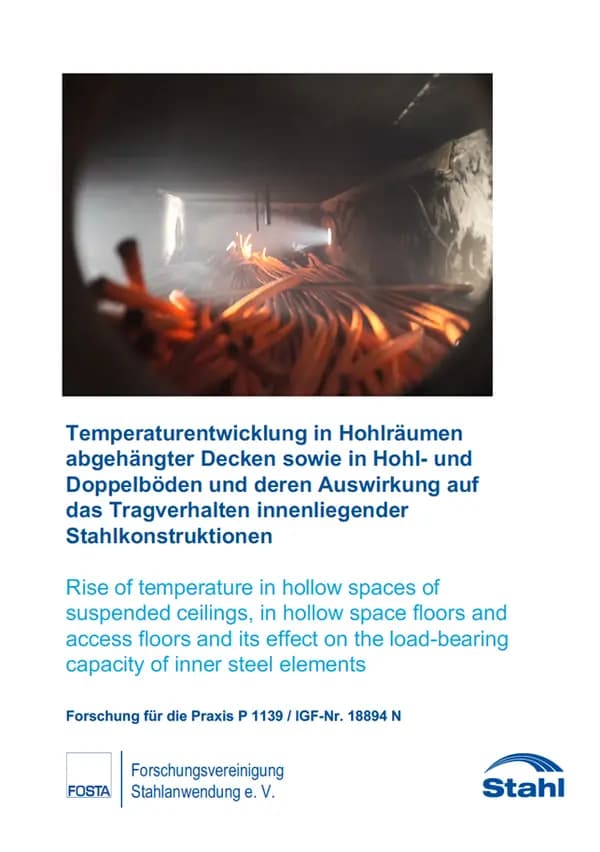
P 1139 - Temperature development in cavities of suspended ceilings as well as in hollow and raised floors and their effect on the load-bearing behaviour of internal steel structures Today's modern buildings must fulfil functional, economic and ecological requirements to achieve climate protection goals. Integrated and multifunctional ceiling systems, which include the integrated and sustainable InaDeck composite ceiling system, are an integral part of these buildings. From a fire protection point of view, multifunctional ceiling systems must fulfil the performance criteria R (load-bearing capacity), E (room closure) and I (insulation) for fire resistance durations of up to 90 minutes with a fire exposure in accordance with the standard temperature-time curve (ETK) below the ceiling system. In addition to the fire protection requirements for fire exposure below the ceiling system, further fire protection requirements (R30) are placed on the supporting structure of the ceiling system, which is located in the suspended ceiling as well as in hollow and raised floors, within the ceiling. Recent research results have shown that the fire protection design (R30) of the ceiling systems within the ceiling void is very conservative when using the ETK. The research project is dedicated to the question of developing a natural fire scenario for the ceiling void for a realistic assessment of the load-bearing behaviour of the InaDeck ceiling system as a result of the natural fire scenario developed for suspended ceilings as well as for hollow and raised floors. In addition to the experimental investigations for the development of a fire scenario for the ceiling cavity and the evaluation of the effects on the load-bearing behaviour of the ceiling system, the influence of fire protection bulkheads in suspended ceilings and in hollow and raised floors on the temperature development in the ceiling cavity was analysed and the load-bearing behaviour of composite dowel strips in clothoid form was quantified at elevated temperatures. Based on an online survey and interviews with experts, the fire loads (electrical cables) and the ventilation conditions within a suspended ceiling and in hollow and raised floors were identified. This data collection forms the basis for the small-scale investigations to develop a natural fire scenario for the cavity of suspended ceilings as well as hollow and raised floors, which is referred to below as "fire in the cavity". The small-scale tests form the basis from which the natural fire scenario "fire in the cavity" was derived. In addition, the influence of openings and fire protection bulkheads in suspended ceilings as well as in hollow and raised floors on the temperature development in the ceiling cavity was assessed with the help of two large-scale fire tests. Two large-scale fire tests were carried out to assess the effects on the load-bearing capacity of the InaDeck ceiling system as a result of the natural fire scenario developed for the ceiling cavity. The experimental tests were used to quantify the system load-bearing effect and the effects on the load-bearing behaviour. Publication: January 2021 Authors: Prof. Dr.-Ing. M. Mensinger, M.Sc. S. Koh, Prof. Dr.-Ing. P. Schaumann, M.Sc. P. Meyer
available anytime
€30.00
excl. VAT
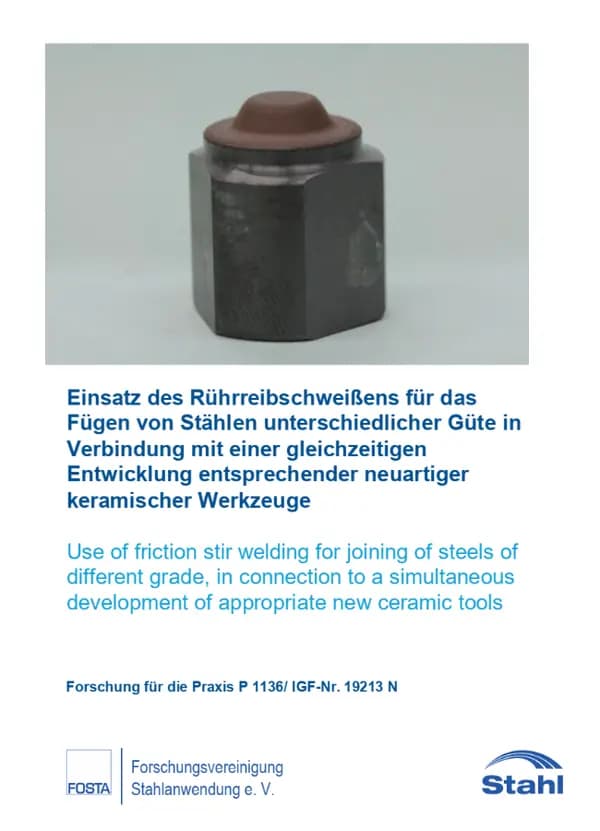
P 1136 - Use of friction stir welding for joining steels of different grades in conjunction with the simultaneous development of corresponding new types of ceramic tools The most important and first development objective of the project was the economic expansion of friction stir welding (FSW) for joining steel materials, including those with high strengths. A great deal of previous experience available at SLV Berlin-Brandenburg and experimental applications were incorporated into the project. Based on enquiries, mainly from the areas of shipbuilding, offshore, vehicle construction and special applications and requirements from the Project Advisory Committee (PA), steel joints of various grades were welded and analysed. These include, among others: S235, S355, S690, CrNi18-10 and H800. Blind seams, butt joints and lap joints were welded. For two steel grades, the butt joint was also welded on both sides to record greater thicknesses. In addition, it was examined whether the use of shielding gas was necessary and how this could be optimised (simple gas nozzle above the stirring tool, drag nozzle, etc.). This was dispensed with in the further course of the project. No significant advantages could be identified. Material tests such as tensile tests, bending tests, X-rays etc. confirm this tendency. The tested samples consistently showed quality values in the range of the base material. The second important aspect of the project was tool development. This is also the main reason why FSW on steels is not very common (except for university or institutional research applications). During the friction stir welding process on steels, the friction stir tools are exposed to extremely high temperatures ~1200°C (e.g. only ~500°C for aluminium), corrosive and abrasive wear. Tungsten-rhenium alloys are mainly used for FSW steel welding (WRe05, WRe25), but other special metallic materials such as tantalum-based materials and solid carbides are also used. Another variant is tools made of polycrystalline cubic boron nitride (pcBN). Conventional ceramic material systems offer a further, promising and much more economical option. These systems in particular were investigated in the research project by SLV Berlin-Brandenburg and FGK GmbH from Höhr- Grenzhausen. It was important to understand the interactions between the material to be welded and the ceramic tool. Derived from the tests and the subsequent laboratory investigations, a material system crystallised, silicon nitride. This material, chemical formula Si3N4, a non-oxide ceramic, has proven itself in all the steels tested. Oxide ceramics, on the other hand, although easier to produce, were not convincing. Only in the course of the project, and only towards the end, were improvements achieved in some oxide ceramics through special geometric and chemical adjustments. However, this is also an important result of the research project: Understanding the failure mechanisms and their effects on the various ceramic material systems. Ultimately, however, it can be said that the Si3N4 material is essentially ready for use. This was clearly demonstrated and confirmed by the results of the reference tests. This means that at least one material system has been verified for friction stir welding on steel. Publication: May 2021 Authors: R. Boywitt, Dr.-Ing. M. Emmel
available anytime
€30.00
excl. VAT
P 1135 - Hot moulding process integrated surface structuring for hybrid components Due to increasing requirements in the areas of safety, comfort and lightweight construction, the demand for structural parts made of ultra-high-strength steels is growing in the automotive body-in-white. By using these steels, the sheet thickness of the components can be reduced and thus the weight lowered. However, the production of complex geometries proves to be problematic due to the high mechanical strength, as large loads act on the forming tools and the process accuracy is impaired by the springback behaviour. The press hardening process provides a solution to this problem. Press hardening is a non-isothermal process that combines the forming of the component and the hardening of the material. In this process, martensitic hardening of the sheet metal component can be achieved. However, stability problems with reduced sheet thicknesses limit the lightweight construction potential of press-hardened components. In other branches of industry, such as the aerospace industry, structural components are often made from fibre-reinforced plastic composites (FRP) or, in more recent approaches, in a hybrid composite of metal and FRP, while high-strength steels continue to dominate the automotive mass market. A targeted combination of metal and FRP leads to stress-adapted and cost-effective hybrid lightweight structures. In the load application area of such hybrid components, concentrated, three-dimensionally effective load collectives often occur, which are preferably absorbed by isotropically acting metallic components. The transition area or the interface from the metallic component to the fibre composite structure, where the forces have to be transferred, is critical. New surface pre-treatment processes can help to improve component performance by creating targeted interlocking effects. The aim of this project is to develop a process that introduces surface structuring into the hot forming process of high-strength steels in order to subsequently achieve improved bonding of fibre-reinforced plastics. The structuring is applied using the corresponding hot forming tool, which eliminates an additional work step compared to other structuring processes. For this purpose, a tool for structuring at sample body level is first developed, with which the samples are simultaneously structured and hardened. The mechanical properties of the hybrid structures made of FRP and 22MnB5 are then determined experimentally. Based on the knowledge gained, the method is then applied to an automotive body structure and validated. Publication: 2020 Authors: T. Tröster, K. Dröder
available anytime
€30.00
excl. VAT
Payment by card (Stripe) or invoice (DE, AT, CH). Download link by email: automatically after ordering by card, after order approval for invoice (valid for 30 days). Terms