The research project "Statistically safeguarding small series in steel processing" focussed on the development of a concept for the introduction of statistical process control (SPC) in small series production. The focus …
The research project "Statistically safeguarding small series in steel processing" focussed on the development of a concept for the introduction of statistical process control (SPC) in small series production. The focus was on the steel processing value chain. The particular potential of the concept includes a sustainable increase in product quality and a reduction in scrap and quality costs. The basic approach for the concept development was the development of a similarity model for the expert-based grouping of small series on the basis of similar quality characteristics and processes with the help of a suitable classification and coding system.
By analysing entire small series groups within the framework of statistical process control, it is possible to increase the number of available samples and thus also the statistical reliability. The latter can be quantified using a developed risk model. The quantified certainties provide a basis for describing similarities between small batch groups and their small batches. In addition, a similarity measure can be derived that can be used to evaluate the small series groups formed. The implemented KleiSta software demonstrator makes it possible to visualise the group samples in the context of adapted interactive quality control charts and calculates the statistical certainties for various quality statements as well as the similarity measures. The Fraunhofer Institute for Production Technology IPT developed the concept and the KleiSta software demonstrator as the executing research centre and project coordinator during the project period from 1 September 2015 to 31 August 2017 in close cooperation with a project support committee consisting of the following 14 manufacturing companies (small, medium-sized and large companies) and with the Forschungsvereinigung Stahlanwendung e.V. (FOSTA): - 3win Maschinenbau GmbH - ArcelorMittal Ruhrort GmbH - ASK GmbH - Bittner Werkzeugbau GmbH - EZM Edelstahlzieherei Mark GmbH - Innolite GmbH - Krott & Heuter GmbH - Leistritz Turbomaschinen Technik GmbH - Lemken GmbH & Co KG - Ortlinghaus-Werke GmbH - Phiesel GmbH - Rolls-Royce Germany Ltd & Co KG - Saarstahl AG - Ziehwerk Plettenberg GmbH & Co KG I n the course of the research project, regular committee meetings and topic-specific workshops provided a platform for the participating companies to define individual requirements for the concept and the KleiSta software demonstrator as well as suitable small series products and processes for the application of statistical process control. Individual meetings were also held to identify and compile available data that could be used for initial sample analyses and subsequent validation. Further information on the project can be found on the website www.kleista.de.
Payment by card (Stripe) or invoice (DE, AT, CH). Download link by email: automatically after ordering by card, after order approval for invoice (valid for 30 days). Terms
Machine-translated title and description. The document itself is in German.
Digital download
Other parts and editions as well as neighbouring documents of the same series.

P 1110 - Localised laser heat treatment of work-hardened steels to improve forming and functional properties for lightweight construction in the automotive industry The overarching research objective of the project was to use a combination of cold rolling and local laser heat treatment to achieve customised properties in steel blanks with regard to formability and crash behaviour for the subsequent forming process and later use in the automobile. To investigate this approach, a cost-efficiently producible ferritic steel, the micro-alloyed S550MC, and an established steel with high application relevance, the dual-phase steel HCT780X, were selected. Firstly, the temperature ranges in which relevant softening mechanisms occur depending on the degree of rolling were determined. For this purpose, short-term heat treatments similar to laser softening were carried out in a forming dilatometer and the resulting mechanical properties were then tested in a tensile test at room temperature. The results serve on the one hand as a target value for the process development of localised laser heat treatment and on the other hand as a basis for the material data required in the simulation. In deep-drawing simulations of a work-hardened cross-section, softening strategies for maximising the drawing depth were developed, while in crash simulations of a hexagonal hollow profile, softening strategies for increasing the energy absorption were determined. The most promising strategies were verified in real tests and the methodology developed was validated using a sample component, a B-pillar. The results of this interdisciplinary collaboration prove that the design and optimisation of local heat treatment areas is possible in principle using simulation. To increase the formability, it is most effective if potential failure areas are work-hardened and surrounding areas are softened to enable flow. The improvement in crash behaviour can be demonstrated in drop tower tests: Crash boxes produced using the process combination exhibit an up to 28% shorter compression path compared to a conventional crash box with the same energy absorption. The production of the sample component shows that process limits can also be predicted with the aid of simulation. When integrating local laser heat treatment into the sheet metal forming production chain, straightening to minimise the resulting distortion and the removal of the laser-induced oxide layer before galvanising to ensure corrosion resistance must also be taken into account. A scanner and special optics with a customised beam profile were tested to increase the feed rate of the laser irradiation. The combination of cold rolling to increase strength and laser heat treatment for localised softening revealed new potential for lightweight construction and crash safety. According to the results, the potential of the investigated process combination can be rated as high. Publication: 2018 Authors: Prof. Dipl.-Ing. G. Hhirt, Prof. Dr rer. Nat. R. Poprawe
available anytime
€30.00
excl. VAT

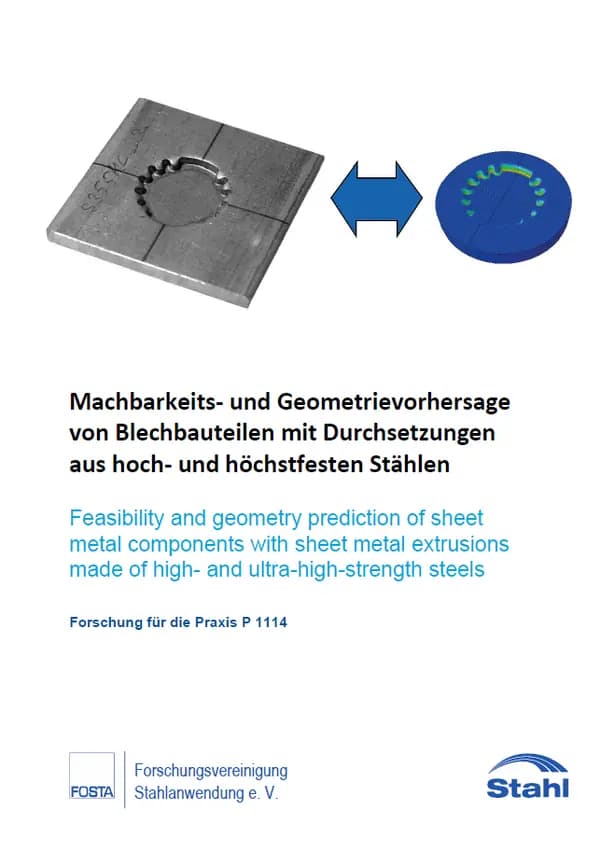
P 1114 - Feasibility and geometry prediction of sheet metal components with high and ultra-high strength steels Reducing manufacturing costs is a key factor in increasing the competitiveness of manufacturing companies. In this context, clinching offers great potential, as this process makes it possible to produce functional surfaces in just one production step and without post-processing. Push-through forming is defined in DIN 8587 as a shear forming process in which one workpiece part is displaced relative to another with a rectilinear tool movement. The plastic deformation is achieved, analogous to fine blanking or shearing shear cutting with a small cutting gap, plastic deformation is mainly caused by a state of shear stress. The tool technology and tool kinematics of the processes are also similar. This leads to the conclusion that piercing largely corresponds to a cutting process without cutting through the workpiece. In order to reduce the weight of components and to be able to dispense with a tempering process, sheet metal made of high-strength and ultra-high-strength steel is increasingly being used. However, there is hardly any experience in the design and development of these grades. In order to ensure the safety of the process in the early development phase the process is simulated using the finite element method. This poses particular challenges in terms of material modelling. It is known from shear cutting that the temperature in the shear zone can rise to over 300 °C. Furthermore, degrees of deformation and strain rates are to be expected that cannot be modelled using conventional experiments such as the tensile test. In order to reduce the experimental effort, a methodology is presented and validated in this research project in order to nevertheless enable an efficient prediction of the geometry and feasibility of a sheet metal component with through-set. For this purpose, the interleaving line is broken down into recurring mould elements. The characteristic shape of these interspersions is determined experimentally for four different sheet metal materials. materials. Subsequent material modelling based on a simple test procedure is used as the starting point for determining the correction model. This is followed by an adjustment of this model in order to minimise the deviation between simulation and experiment. By interpolating between the mould elements, it is possible to adapt the material model locally for complex interspersion geometries. This makes it possible to assess the feasibility and geometry of interspersions made of high-strength and ultra-high-strength steels at an early stage of development. Authors: Prof. Dr.-Ing. W. Volk, J.-M. Stahl M.Sc. Publication: March 2020
available anytime
€30.00
excl. VAT

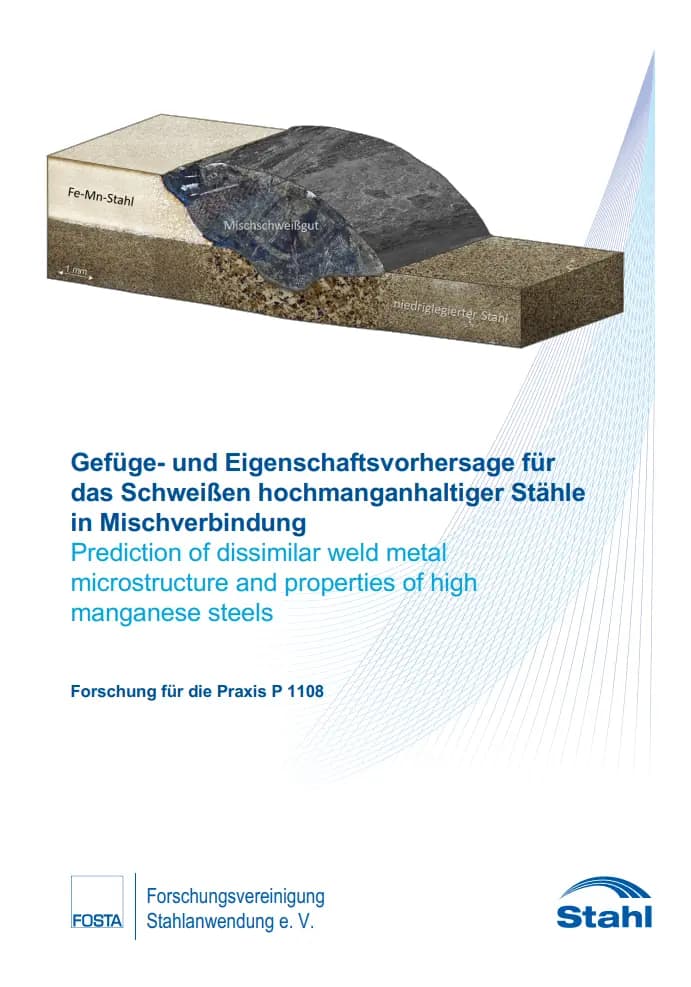
P 1108 - Microstructure and property prediction for the welding of high-manganese steels in dissimilar joints The primary aim of the research project was to improve the welding processing of high-manganese steels in dissimilar joints by predicting the microstructure and properties of the dissimilar weld metal using a newly developed constitution diagram. Three economically relevant Fe-Mn steels with different alloying concepts were used as test materials. The steels HC340LA (1.0548) and 22MnB5 (1.5528), which are widely used in car body construction, were used as joining partners. Various high-manganese metal powder flux-cored wire electrodes were also available. Using a TIG arc melting furnace, a remelting method was developed for experimental weld metal simulation, which makes it possible to produce mixed weld metals of any material combination in defined mixing ratios under MSG-adequate cooling conditions. Using this method, a large number of remelting samples (dissimilar weld metal) were produced in a wide range of different chemical compositions, which were characterised in terms of microstructure type, microstructure proportions, hardness and ferrite number. A total of eight microstructure groups were determined, which can occur in the mixed weld metal depending on the material combination and mixing. The different martensite types ε and α' are of particular importance, as these cannot always be clearly distinguished metallographically, but differ significantly in their properties. The results show that the paramagnetic ε-martensite mainly occurs in dissimilar weld metal with a relatively high Mn content. The α'-martensite, on the other hand, is found in dissimilar weld metals with lower Mn contents, i.e. with higher admixtures of low-alloy ferritic or martensitic joining partners or when using low-alloy filler metals. A high hardness in the dissimilar weld metal investigated here is directly associated with the formation of α'-martensite, which is why it is essential to differentiate between the two types of martensite. Investigations into the influence of the cooling rate showed that a significant increase in the cooling rate only has a significant influence on the microstructure and hardness in a few mixing ratios. This applies in particular to dissimilar weld metals with a very high admixture of low-alloy ferritic or martensitic joining partners or low-alloy filler material. It can therefore be assumed that very similar microstructural states and hardness values can be expected in the dissimilar weld metal in welding processes with higher cooling rates than in MIG welding (assuming homogeneous mixing). On the basis of the experimentally simulated dissimilar weld metals and the weld metal properties determined from them, a comprehensive data set was recorded, with the help of which equivalents were derived using statistical evaluation methods, which span the axes of the newly developed constitution diagram, the so-called COHMS diagram. In addition to the microstructure prediction in MSG weld metals, the COHMS diagram enables a rough estimation of the resulting weld metal hardness on the basis of HV-ISO lines. validation of the COHMS diagram using real MSG welds resulted in a very good prediction accuracy. 89 % of the MSG weld metals were predicted correctly. The remaining 11 % were close to the limit lines. The investigations into the influence of the microstructure type - in particular the martensite content - in the mixed weld metal on the mechanical-technological properties of the welded joints showed that a weld metal microstructure of austenite + α'-martensite in particular is to be regarded as extremely critical. The tested joints with this weld metal microstructure exhibited significantly poorer strength values under both static and dynamic impact loads compared to the other welds and predominantly failed in the weld metal Publication: September 2019 Institute of Materials and Joining Technology at Otto von Guericke University Magdeburg Prof. Dr.-Ing. Sven Jüttner M. Sc. Benjamin Wittig Dr Manuela Zink Participating companies: ArcelorMittal Global R&D, Zelzate Benteler Steel/Tube GmbH, Paderborn CIF GmbH, Grünstadt Corodur Verschleiss-Schutz GmbH, Thale Dr Rosert RCT GmbH, Dresden Kirchhoff Automotive Deutschland GmbH, Attendorn MSS Magdeburger Schweißtechnik GmbH, Barleben MSZ GmbH, Blankenburg Outokumpu Nirosta GmbH, Krefeld Salzgitter Mannesmann Forschung GmbH, Salzgitter thyssenkrupp Hohenlimburg GmbH, Hagen Volkswagen AG, Wolfsburg Vorrichtungsbau Giggel GmbH, Bösdorf Research institution(s): Institute for Materials and Joining Technology at Otto von Guericke University Magdeburg Responsible for FOSTA - Forschungsvereinigung Stahlanwendung e. V. Dipl.-Ing. Rainer Salomon
available anytime
€20.00
excl. VAT

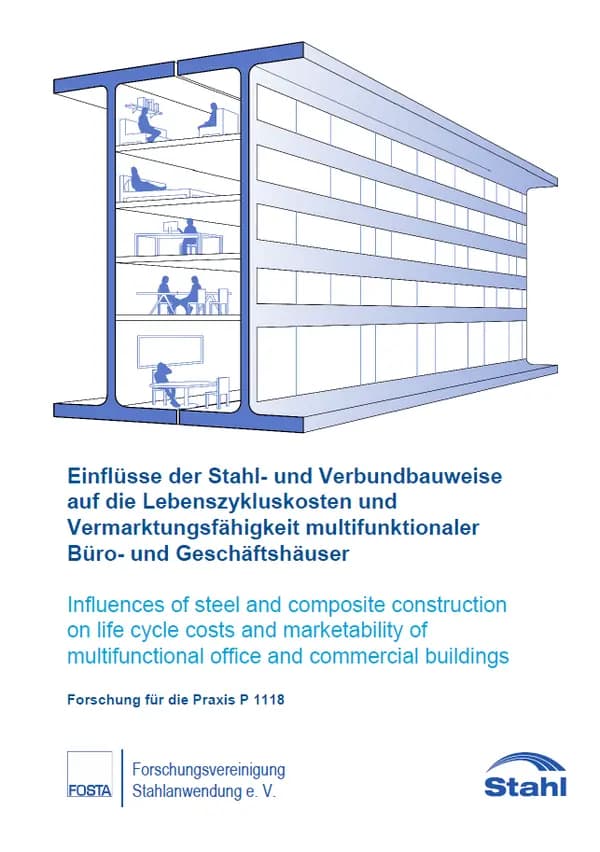
P 1118 - Influences of steel and composite construction on the life cycle costs and marketability of multifunctional office and commercial buildings Demographic change and increasing sustainability awareness are examples of changing social conditions that have an impact on the user requirements for multi-storey buildings. Resource conservation, recyclability, life cycle costs and value retention, even under changing property conditions, are increasingly at the centre of planning. The competitiveness of rental and usable space depends, among other things, on whether the spatial structures offer the necessary flexibility to adapt to these dynamic processes. Experience in recent decades has shown that the construction of low-cost monofunctional building structures and urban districts, as has been the case in many places since the 1970s, often leads to premature vacancies and even demolition, as the primary structure is not sufficiently adaptable. The aim of the research project was to develop multifunctional building structures and to utilise the potential of steel and composite construction. This should increase the long-term marketability and sustainability of the properties. The subject of the research report is firstly an analysis of the current situation of the property market and the causes of structural vacancy. This is followed by a presentation of revitalisation projects that have already been carried out and a summary of the findings for property planning. The basics of the sustainability assessment of buildings and building elements as well as the assessment methods used in the project are presented in the second chapter. Based on the findings from previous revitalisation projects, Chapter 3 develops recommendations for the property planning of multifunctional buildings. The requirements of different types of use, such as clear storey height, building depth or access, are summarised. The requirements of variable building structures result from the overlapping of these aspects. These are illustrated using designs of reference buildings with different degrees of variability. Building on the property planning requirements, Chapter 4 derives the design implications resulting from multifunctional utilisation. The properties of classic and multifunctional ceiling systems in composite construction as well as the influences of fire protection, façades and building foundations are analysed. The ecological, monetary and functional influences of the various building components are assessed in parameter studies. The effects of increased variability and the extension of the service life are analysed using the reference building as an example. Chapter 5 analyses the market segments relevant to the research project and their development. Furthermore, the utilisation type-specific revenues and monetarily assessable risks are determined. The investigations form the basis for stochastic scenario analyses, through which a statement can be made on the fluctuation range of the forecast costs, revenues and defined target figures. Building on this, Chapter 6 uses the example of the reference buildings to determine the expected returns based on the return on equity for various conversion scenarios. The effects of the individual input parameters are analysed in sensitivity analyses. The analyses carried out show that suitable planning precautions can increase the variability of building structures and enable a variety of uses. The steel and composite construction method with efficient load-bearing structures allows the adaptability of buildings without significantly increasing the ecological or monetary costs of construction. If the extension of the life cycle is created by the increased variability, there are clear advantages. Ultimately, the profitability analyses show that a higher initial investment leads to a long-term increase in returns and a reduction in the risk of vacancy in many scenarios. Publication: March 2020 Authors: Prof. Dr.-Ing. Richard Stroetmann, Dipl.-Ing. Lukas Hüttig, Prof. Dipl.-Ing. Johann Eisele, Dipl.-Ing. Architect Benjamin Trautmann, Prof. Dr.-Ing. Dipl.-Wirt.-Ing. Jens Otto, Dipl.-Ing. Anne Harzdorf, Dipl.-Ing. Cornell Weller
available anytime
€30.00
excl. VAT
Payment by card (Stripe) or invoice (DE, AT, CH). Download link by email: automatically after ordering by card, after order approval for invoice (valid for 30 days). Terms