The mathematical prediction of the behaviour of railway bridges is often unsatisfactory. In many cases, measurements can show that the bridge structure in question behaves much more favourably in reality than in the …
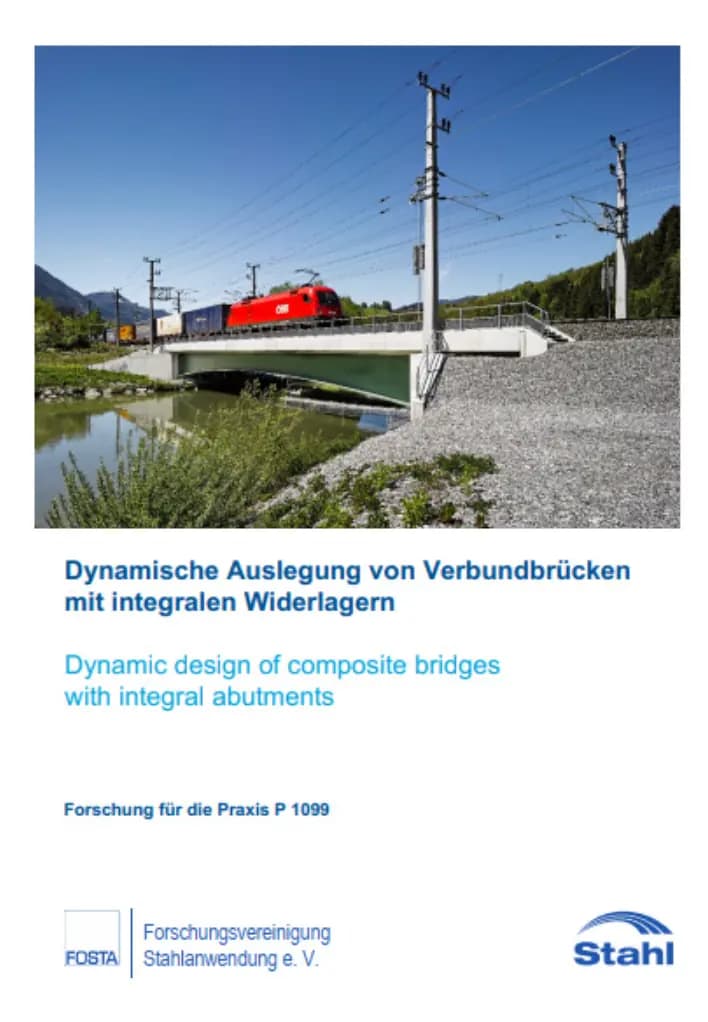
P 1099 - Dynamic design of composite bridges with integral abutments The mathematical prediction of the behaviour of railway bridges is often unsatisfactory. In many cases, measurements can show that the bridge structure in question behaves much more favourably in reality than in the calculation. As railway bridges are sometimes subjected to very high dynamic loads due to the regular centre distances of the trains passing over them, it is important to predict the natural frequencies and associated modal shapes, which can be excited by vertical loads, as accurately as possible. The damping properties of the structure are also of interest.
The differences between calculated and measured natural frequencies are at least partly due to the fact that the contributions of certain structural elements to system stiffness and damping cannot be taken into account in structural modelling according to current standards. For bridges with integral abutments, there is also the question of the contribution of the backfill material. To clarify this issue, the frame bridge over the Salzach was analysed in several construction stages. The measurement results are presented in Chapter 2 of this report. As only a negligible influence of the backfill material could be observed for this bridge in particular, additional parameter studies were carried out using numerical models. These are presented in Chapter 3. In addition to the dynamic short-term loads caused by the passing trains, the influence of seasonal differences on the supporting structure must be analysed for bridges with integral abutments. For example, seasonal elongation and shortening of the superstructure results in a change in the earth pressure load or in a change in the dynamic properties of the "structure - backfill" system. Chapter 4 of this report presents and analyses the measurements carried out on the Rednitz Valley Bridge. The Rednitz Valley Bridge is a 170 m long integral bridge. The focus of the measurements is on analysing the deformations of the integral supporting structure and the stress on the track in the area of the structure and the transition to the embankment under climatic influences (long-term monitoring). The aim of the measurement is to characterise the thermal expansions of the superstructure and the interaction with the backfill area. Based on the findings on the structural deformations, the rail stresses are analysed and prepared for a subsequent model comparison. for a subsequent model comparison. The knowledge gained in the project on the realistic modelling of railway bridges with integral abutments is summarised for the user in Chapter 6. The original objective of the research project was thus achieved.
Payment by card (Stripe) or invoice (DE, AT, CH). Download link by email: automatically after ordering by card, after order approval for invoice (valid for 30 days). Terms
Machine-translated title and description. The document itself is in German.
Digital download
Other parts and editions as well as neighbouring documents of the same series.

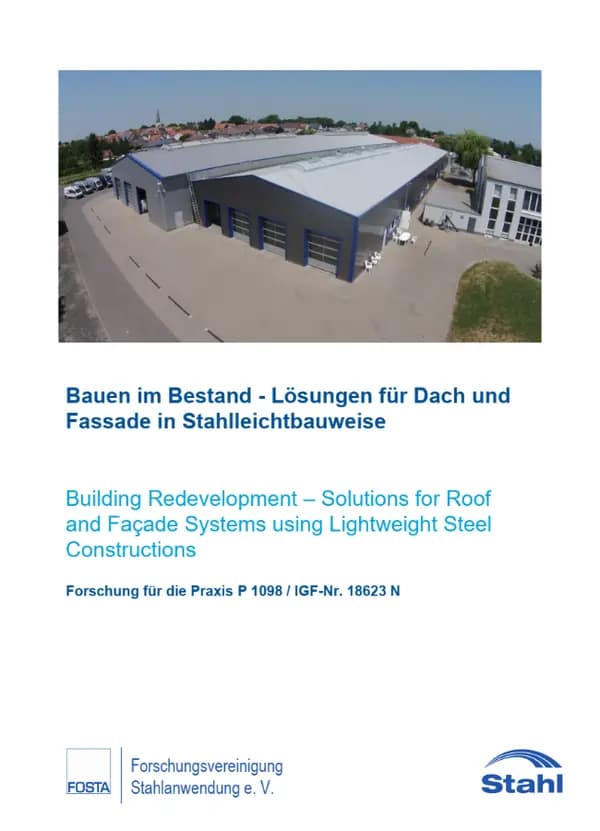
P 1098 - Building in existing structures - Solutions for roofs and façades in lightweight steel construction Energy-efficient refurbishment and construction in existing buildings are becoming increasingly important in the context of climate protection policy. Various studies show that a significant reduction in emissions and energy consumption in the building sector can only be achieved through energy-efficient refurbishment of existing buildings. In industrial and commercial buildings in particular, the thermal energy quality of the building envelope realised in the past often no longer meets the requirements. This research project pursues the approach of being able to carry out energy-efficient refurbishments during ongoing operation (i.e. without cost-intensive loss of use). In order to improve the thermal quality of the existing façade, additional heat-insulating components are to be installed on the outside. The use of lightweight steel and metal construction systems is seen as particularly promising. Sandwich elements with steel facings on both sides and a polyurethane or mineral wool insulation core are an extremely effective option in this context. possibility in this context. Not only do they have very good thermal properties, they can also be installed particularly quickly and economically. In addition, so-called modular lightweight steel construction systems offer another alternative for upgrading the energy efficiency of existing building shells. Priority is given to existing buildings whose roof and façade areas have already been constructed using lightweight steel construction, with the focus being on steel cassette façades. In addition, existing façades and roofs in solid construction are also the subject of the research project with regard to possible refurbishment with building systems in lightweight steel construction. From a building physics point of view, not only the aspects of thermal insulation are being investigated, but also issues arising from the change in the moisture behaviour of the building component to be refurbished. Structural boundary conditions must also be taken into account in energy-related refurbishments. Existing components affected by the refurbishment must be statically verified again on the basis of current technical regulations and the approaches for wind and snow loads have been subject to major changes in recent decades. After a systematic survey of the normative development in this sector, possibilities are being investigated to verify the energetically refurbished building elements using the then additionally available lightweight steel construction systems with correspondingly changed load assumptions. The aim of the research project is to develop rules and design approaches which, on the one hand, allow statements to be made on the energy quality achievable with the refurbishment and its effects on the moisture behaviour of the building components. On the other hand, possibilities are being developed that cover the structural aspects resulting from the combination of the existing verification of the existing structure and the current load assumptions in connection with the refurbishment measure. Publication: January 2021 Authors: Univ.-Prof. Dr.-Ing. M. Kuhnhenne, Dipl.-Ing. M. Brieden, Univ.-Prof. Dr.-Ing. D. Ungermann, Dipl.-Ing. A. Wiegand
available anytime
€30.00
excl. VAT

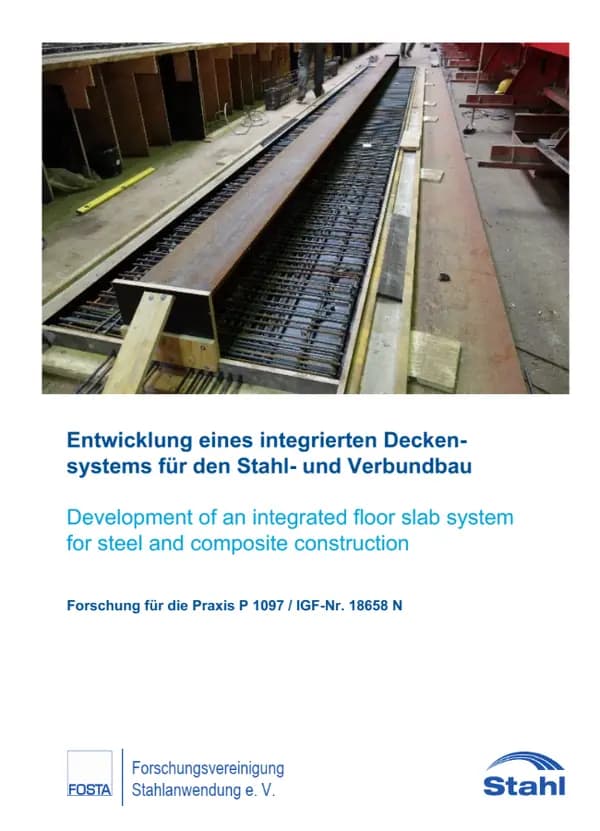
P 1097 - Development of an integrated floor system for steel and composite construction The aim of the research project is the development of an integrated floor system for steel and composite construction and the derivation of engineering models to describe the floor load-bearing behaviour. The starting point is the InaDeck floor system, which was designed as part of the FOSTA research project P 879. This is characterised by large spans and the building technology integrated in the ceiling void. In order to bring the ceiling system to demonstrator maturity, the individual ceiling elements must be optimised in terms of load-bearing capacity, cost-effectiveness and resource consumption (rolled profiles and composite materials), and the integration of the ceiling system into the overall structure must be developed. In this research project, possible system and cross-section variations that allow for a flexibilisation of the grid dimension are first examined. Based on this, existing steel connection constructions to columns and alternating beams are analysed and adapted for the ceiling system. For the friction-locked joints between the floor elements, grouted joints as well as detachable and theoretical analyses are investigated. For this purpose, the load-bearing and load-bearing capacity showed a decrease in the load-bearing capacity with increasing tensile load. A similar effect was also observed in the tests in cracked concrete. In the shear tests with additional transverse bending, a reduction in the load-bearing capacity was also observed, but this was not confirmed in the girder tests. In final girder tests, the load-bearing mechanisms in the web opening area under positive and negative moment loading on the one hand and the influences of combined transverse and longitudinal bending loading in the floor element on the other were investigated. The vibration behaviour of the lightweight composite floor is analysed on a 10.5 m long composite floor element with an increasing number of web openings. This showed a positive effect on the natural frequency with web openings in the support area. The damping of the floor was consistently low. Engineering models for the floor system were derived on the basis of the investigations carried out. The result of the research is an integrated steel composite floor system for modular, long-span load-bearing structures that is ready for dismantling. Publication date: January 2021 Authors: Dipl.-Ing. M. Kopp, Prof. Dr.-Ing. M. Feldmann, Dr.-Ing. M. Claßen, Prof. Dr.-Ing. J. Hegger
available anytime
€30.00
excl. VAT

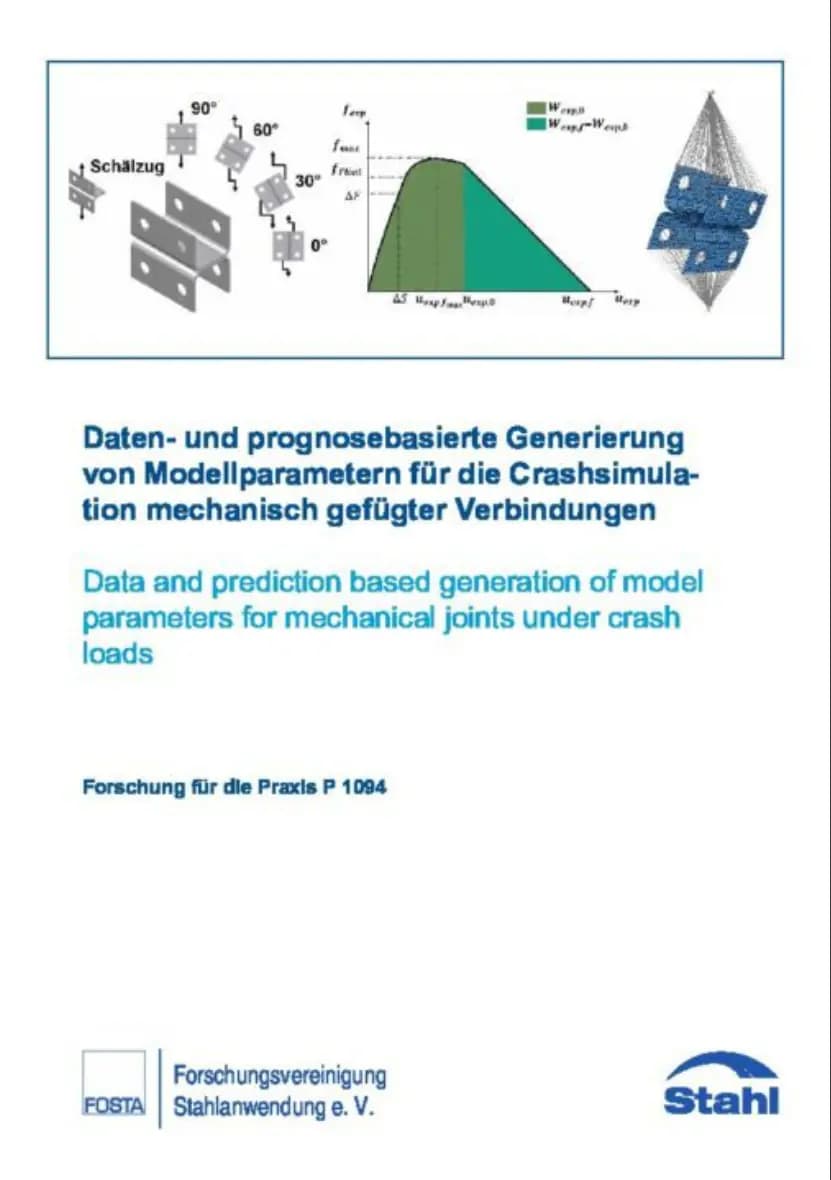
P 1094 - Data- and prediction-based generation of model parameters for the crash simulation of mechanically joined joints Due to the increasingly focussed implementation of innovative lightweight construction concepts, mechanical joining processes (semi-tubular self-pierce riveting, solid self-pierce riveting, flow-piercing bolting, lockbolting and high-speed bolting) are increasingly being used in multi-material constructions. These material combinations and mechanical joining processes can be subjected to high loads (crash load case). For the crash simulation of new types of mechanically joined connections, however, complete models for predicting the load-bearing behaviour in the crash load case are still lacking. Furthermore, a large number of practical experiments and measurements for model parameter identification and calibration of the equivalent models are necessary for the equivalent modelling of joints of entire vehicle structures. This is unrealistic due to the variety of joint pairings in a vehicle structure, and it would also be time-consuming and cost-intensive. The aim of the research project was, on the one hand, to develop a prediction functionality for determining characteristic values for unknown joints for all mechanical joining processes currently in use, which, together with experimentally determined data, serve as a data basis for an FE replacement model for the crash simulation of mechanically joined joints. On the other hand, the existing FE replacement model for crash simulation was adapted to other mechanical joining methods. Furthermore, a procedure was developed to provide an automated calibration of the input parameters for an FE substitute model for crash simulation from the predicted and measured data. The validation of the prediction results and the FE replacement models for crash simulation was carried out by means of tests and simulations at sample and specimen component level. By creating a database and the possibility of predicting characteristic values of mechanically joined connections that have not yet been measured in reality, as well as FE substitute modelling for the crash simulation for the above-mentioned mechanically joined connections, connection failure can be mapped in the crash simulation as early as the design phase and its effects evaluated. This enables users, designers and calculation engineers to optimise components and increase their performance. With a forecast and automated generation of model parameters for the calculation of an FE replacement model, this can be carried out in a time and cost-saving manner without first having to carry out lengthy and expensive series of tests and simulations to determine the parameters. The IGF project 18468 BG of the Gesellschaft zur Förderung angewandter Informatik e. V., Berlin and the FOSTA - Forschungsvereinigung Stahlanwendung e. V., Düsseldorf, as a cooperating research association, was funded by the Federal Ministry for Economic Affairs and Energy via the AiF as part of the programme for the promotion of joint industrial research (IGF) on the basis of a resolution of the German Bundestag. The project was carried out by the Gesellschaft zur Förderung angewandter Informatik e. V., Berlin, the Fraunhofer Institute for Mechanics of Materials IWM, Freiburg and the Laboratory for Materials and Joining Technology (LWF) at Paderborn University. Society for the Promotion of Applied Computer Science e. V., Berlin Dipl.-Inf. Daniel Herfert M. Sc. Matthias Günther Fraunhofer Institute for Mechanics of Materials IWM, Freiburg Dr Silke Sommer M. Sc. Philip Rochel Laboratory for Materials and Joining Technology (LWF), University of Paderborn Prof. Dr.-Ing. Gerson Meschut Dr David Hein M. Sc. Patrick Giese Responsible for FOSTA - Forschungsvereinigung Stahlanwendung e. V. Dipl.-Ing. Franz-Josef Heise
available anytime
€40.00
excl. VAT

P 1092 - Quality assurance for electromagnetically pulsed welded joints (QuaSiMPS) As part of the project, investigations were carried out to assess the weldability of a high-strength aluminium alloy EN-AW-6016-T6 with dual-phase steel HCT780X using magnetic pulse welding. The process window for producing perfect welded joints with this combination of materials was created using numerous series of tests and validated by destructive testing. The influence of welding process parameters on the welding result was documented. The knowledge gained from this could be transferred to functional samples close to the application. Possible irregularities in the joining of mixed joints (aluminium-steel) using MPS technology were analysed and characterised. The results were summarised in the form of a defect catalogue based on DIN EN ISO 6520-2. The location of the respective irregularities in relation to the joining surface was described schematically and illustrated by an example using metallographic examination (cross-section). The suitability of inductively excited thermography as a non-destructive testing method for assessing the quality of an MPS joint was investigated and proven as part of the project. The methods required for reproducible defect introduction were developed and presented, and the test specimens produced were subjected to thermographic testing. A distinction was made between fault-free and faulty MPS joints. The findings of defect detection with the aid of active thermography could also be transferred to application-oriented, magnetic pulse welded functional samples. The characteristics of the joining surface in MPS and its influence on the strength of the welded joint were analysed. The correlation between the effective weld seam area and the maximum bearable tensile shear load was demonstrated. The size of the joint area can therefore be used to assess the quality of an MPS joint. Active thermography was used to determine the weld seam area of a lap-welded MPS joint with a measurement duration of approx. 0.2 seconds. In order to increase reproducibility and minimise the time required for evaluation, algorithms were developed that enable automated calculation of the joint area using both the microscopy images (evaluation after metallographic examination) and the thermograms. The functionality of the algorithms was validated using the results of the destructive testing and the accuracy was determined. The use of a transient thermal FEM analysis was investigated to further optimise the evaluation methodology of thermographic examinations. Various FEM models and approaches for defining realistic boundary conditions were discussed. A high level of agreement in the qualitative comparison between thermographic analyses and the simulation results demonstrated the enormous potential of this approach. MPS technology provides the user with a welding process that enables high-quality joining of challenging, dissimilar material combinations such as high-strength aluminium alloys with dual-phase steels. Induction-excited thermography can be used for this welding process as a non-destructive testing method to assess the quality of an MPS joint. In addition to detecting weld seam irregularities, it allows the weld seam surface to be determined non-destructively. Publication: 2020 Authors: I. Kryukov
available anytime
€30.00
excl. VAT
Payment by card (Stripe) or invoice (DE, AT, CH). Download link by email: automatically after ordering by card, after order approval for invoice (valid for 30 days). Terms