For economical production processes of elementary bonded structural components for series applications, a fast strength build-up to handling strength with the same requirements for production tolerances must be achieved …
For economical production processes of elementary bonded structural components for series applications, a fast strength build-up to handling strength with the same requirements for production tolerances must be achieved in order to continue the production process, if fixing by thermal or mechanical processes is not required. The aim of the research project was to qualify process methods for the rapid hardening of highly stressed, elementary bonded structures of steel-intensive mixed construction in order to realise an economical manufacturing process suitable for series production. Process methods such as the induction process and the hot-air process in combination with suitable adhesive systems for the corresponding application were analysed, evaluated and further developed.
This also included the evaluation of manufacturing influences and the creation of process windows in relation to the process parameters (e.g. temperature, time) and design tolerances (e.g. adhesive layer thickness, heat conduction, etc.) of the joint. In addition, an SME-relevant rapid test was developed, which makes it possible to reduce the effort required to set up a rapid hardening process. In order to develop a quick test that can be used by SMEs and enables the simple selection of adhesives and the parameterisation of rapid curing processes, investigations were first carried out using selected adhesive systems. It had to be examined to what extent a continuous handling strength can be achieved despite increasing sample complexity if the boundary conditions adhesive layer thickness, material-thickness combination and adhesive surface and thus indirectly the heat conduction and the effective degree of conversion gradient are changed. This was done experimentally on the one hand, but also using simulative methods. In addition to assessing the fast-curing properties of adhesives and the simple determination of fast-curing parameters, the main benefits of the investigations and the rapid test are the derivation of recommendations for action and the optimisation of fast-curing processes at the user. With the help of the project results, both users from the automotive industry and their suppliers will be able to design the production processes of elementary bonded structures. Manufacturers of high-speed curing systems and adhesive manufacturers will receive a scientifically validated basis for the further development of their products.
Payment by card (Stripe) or invoice (DE, AT, CH). Download link by email: automatically after ordering by card, after order approval for invoice (valid for 30 days). Terms
Machine-translated title and description. The document itself is in German.
Digital download
Other parts and editions as well as neighbouring documents of the same series.

P 1088 - Development and qualification of a test for rapid electrochemical testing of bonded joints subject to corrosion In painted sheet metal, microscopic paint imperfections at the joint edges have the effect of defects where corrosion processes are initiated by the formation of localised elements. This behaviour can be transferred to bonded joints and in some cases can only be reproduced to a limited extent in laboratory climate change tests. In order to reduce the test duration and the effort required to carry out corrosion tests, a short-term test setup is therefore to be developed to map the corrosion behaviour under real conditions. At the beginning of the project, three application-orientated bondings were defined, which have fundamentally different properties. Two applications come from automotive body-in-white construction and are represented by structural and relining bonding. The manufacturing process and post-treatment are based on body-in-white construction. The third application represents an elastic bonding of the frame structure for solar panels, where no additional corrosion protection is provided. The basic development of the electrochemical corrosion test was based on the simple overlapped shear tensile test. The transferability of the results to more complex test specimens and different load situations was investigated using T-Peel and LWF KS2 specimens. In order to characterise the basic ageing behaviour of the bonded composites, outdoor weathering was carried out as a standardised reference corrosion test in accordance with VDA 621-414. Furthermore, application-orientated climate change tests according to VDA 233-102 and PPV 4017 were used for the single overlapped shear tensile composites. To assess the influence of ageing, the strengths before and after the ageing tests were determined using mechanical testing methods. The resulting failure images and the corrosion products formed were characterised using IR spectroscopy and EDX analysis methods and transferred to a corrosion model. These basic principles were used to vary and evaluate parameters influencing the potentiostatically controlled electrochemical polarisation test. Target parameter spaces were defined on the basis of the corrosion mechanisms using the single overlapped shear tensile specimen. With the developed electrochemical rapid test, it is possible to check the sensitivity of a bonded composite to electrochemical corrosion within a few days and to determine the residual strength. Furthermore, the developed parameters could be transferred to other test specimen geometries with more complex stress conditions. After ageing, all bondings showed the best resistance to the critical, peeling stress. To simplify the test set-up and reduce the amount of equipment required, a rapid electrochemical test with a metal counter electrode was developed and verified with the potentiostatically controlled test. The results of the research project enable small and medium-sized companies in particular to predict the electrochemical corrosion behaviour of bonded joints with little testing effort and thus to design bonded joints in a cost- and time-efficient manner. Publication: 2018 Authors: Prof Meschut, Prof Kötting, Prof Grundmeier
available anytime
€30.00
excl. VAT

P 1087 - Method development for the simulation of the thermomechanical behaviour of adhesive layers in hybrid joints during the curing process When processing thermosetting adhesives in large-scale production in the automotive industry, the adhesive seams within the steel-intensive hybrid structure (car body) consisting of individual components to be joined are cured in a cataphoretic dip coating bath (CDC) together with the corrosion-protective coating. The cathodic dip coating of adhesive seams requires an upstream process after adhesive application to fix the components, which stabilises the structure that is still soft after adhesive application and joining. This necessary handling rigidity and strength is often achieved in bonded mixed steel structures by additional mechanical joining points that are inserted at a fixed distance (hybrid joining). The joint strains and displacements that occur during the heat curing of hybrid-joined structures result in stresses that can lead to damage in the joint area in the form of boundary layer failure or cohesive fractures. The aim of the project is to develop a calculation and evaluation method with which the damage-relevant stresses in the joint can be determined as a function of the material, geometric and process-related influencing variables. For this purpose, both a numerical calculation method and a simple test method with an associated rule of thumb are to be developed, with which the suitability of adhesives for the cathodic dip coating process in steel-intensive mixed structures can be comparatively assessed. The improvement of material, geometric and process-related parameters leads to an optimised lightweight construction. The calculation methods and optimisation options shown enable steel users to avoid damage to the bonded joint due to temperature stresses and the resulting relative displacement of the bonded parts during the curing process. Publication: 2018 Authors: Prof. Dr.-Ing. G. Meschut, Prof. Dr.-Ing. A. Matzenmiller
available anytime
€30.00
excl. VAT

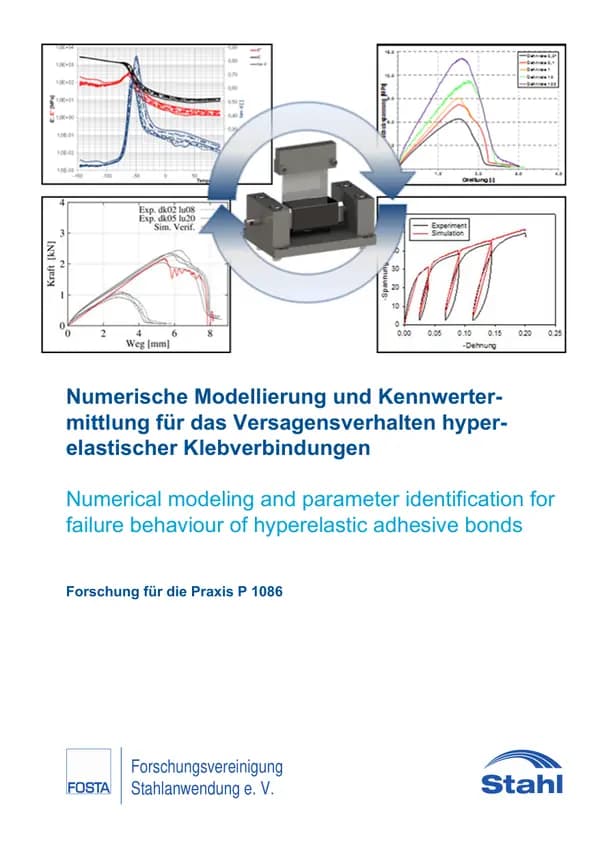
P 1086 - Numerical modelling and determination of characteristic values for the failure behaviour of hyperelastic bonded joints In the field of mobility, mixed modular construction plays a major role. The use of innovative material combinations, such as steel-aluminium, steel-FRP etc., enables weight savings compared to previous designs and thus a reduction in vehicle consumption and emissions. The individual modules, which are increasingly made of light metals and/or FRP, are bonded to the steel vehicle structure during the assembly process using cold-curing elastic and semi-structural adhesives. The aim of the research project is to develop a robust numerical simulation and testing method for the selection of suitable adhesives for the optimal design of assembly adhesive bonds. To calculate the mechanical behaviour of adhesive assembly joints, the hyperelasticity theory was combined with three different calculation methods for failure. The experimental findings of the elastic and post-critical behaviour showed that the elastic behaviour can be described using the MOONEY-RIVLIN model. The failure was described using a fracture mechanics and a damage mechanics approach as well as an approach based on the limitation of the strain energy density. All model parameters were identified using simple basic tests in which the adhesive was subjected to simple tension, simple shear and transverse restrained tension. Finally, all three approaches were validated by calculating two technological and one component-like sample and comparing the results with test data. The progress of the developed calculation methods compared to the state of the art was demonstrated by comparing all calculations not only with tests but also with calculation results obtained with the commercially available *MAT181. Samples of the adhesive with a high glass transition temperature were tested in tension and compression at different strain rates as well as static and cyclic loading in order to capture the strongly rate-dependent behaviour near the glass transition. Two new models were established that take viscoelasticity and viscoplasticity into account and describe the material behaviour under both monotonic loading and cyclic loading/unloading. In addition to tensile and compression tests, experiments on thick tensile shear, planar tensile, angle, strip and head tensile specimens were used for the characterisation with a low glass transition temperature. To describe its material behaviour, a hyperelastic model was developed and combined with viscoelasticity, which resulted in a significant improvement over conventional models. Four experiments were sufficient for parameter identification. The predictions of the model were validated in various experiments with different strain rates. The IGF project 18716 N of FOSTA - Forschungsvereinigung Stahlanwendung e. V., Düsseldorf, was funded via the AiF as part of the programme to promote joint industrial research (IGF) by the Federal Ministry for Economic Affairs and Energy on the basis of a decision by the German Bundestag. The project was carried out at the Laboratory for Materials and Joining Technology at the University of Paderborn, the Institute of Mechanics, Department of Computational Mechanics at the University of Kassel and the Fraunhofer Institute for Manufacturing Technology and Advanced Materials (IFAM), Bremen. Publication: January 2019 Authors: Prof. Dr.-Ing. G. Meschut, Dipl.-Ing. G.Schwarzkopf, Prof. Dr.-Ing. A. Matzenmiller, Dipl.-Ing. A. Nelson, Prof. Dr. rer. nat. B. Mayer, Dr. M. Brede, Dr.-Ing. Mayer, Dr M. Brede, Dr.-Ing. Hesebeck, Dipl.-Ing. A. Wulf
available anytime
€50.00
excl. VAT

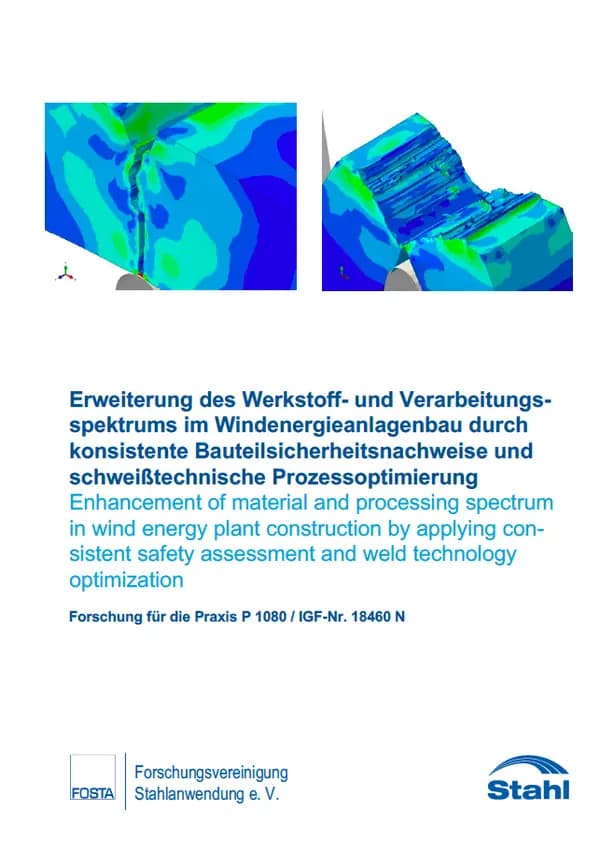
P 1080 - Expansion of the material and processing spectrum in wind turbine construction through consistent component safety verifications and welding process optimisation The motivation for the project arose from the fact that weld seams for wind turbines are currently mainly produced using the submerged arc process, although electron beam welding is much better suited to the large sheet thicknesses that occur in such turbines. The aim of the project presented was therefore to develop the necessary measures to enable EB welding to be used in offshore wind turbines in the future. To achieve this, three main areas of research were pursued. It was investigated how metallurgical and process engineering measures can be used to improve the toughness of EB weld seams. In order to better define the necessary toughness requirements, damage-mechanical models were also further developed so that the required toughness could be specifically derived by simulating notched bar impact tests and components. The third research focus resulted from the motivation not to define the toughness requirements for the entire service life of a wind turbine, but to combine increased material utilisation with safe operation by defining specific inspection and repair intervals. This represents an attractive innovative approach, particularly for offshore wind turbines that are difficult to access, in order to make the manufacture and operation of the turbines more efficient. The investigations into improving the toughness properties made it clear that the chemical composition of the base materials is irrelevant for seam production when welding with excess power, but has a significant influence on the mechanical properties of the joint. A clearly positive influence on the toughness properties was achieved by adding aluminium oxide or aluminium strip as a filler material. The damage mechanics investigations successfully established a local, probabilistic, stress state-dependent cleavage fracture criterion. The probabilistic description of the failure behaviour is based on Weibull distributions. The model was validated using notched bar impact tests in the lower transition range. It can be used in combination with ductile failure criteria to derive toughness requirements. The fracture mechanics analyses were carried out using the simulated load of a 3 MW onshore wind turbine under various situations in the turbine's life cycle. FE calculations to quantify the carding moment generated by the flange geometry led to plausible results for the stress distribution in the weld cross-section. The crack propagation properties of the EB weld seam were defined on the basis of the properties analysed in large-scale tensile tests. It was shown that the chosen approach is suitable for defining inspection intervals. Initial results indicate that EB weld seams have good properties for these applications. The three research foci have provided the necessary knowledge and methodologies to promote the use of EB welded joints in wind turbines. Due to the lack of publicly available data on the operating loads of offshore wind turbines, it was not possible to derive specific toughness requirements and inspection intervals. These should be worked out in co-operation with manufacturers, booms and operators of such turbines. The IGF project no. 18460 N of the Forschungsvereini-gung Stahlanwendung e. V. was funded by the Federal Ministry for Economic Affairs and Energy via the AiF as part of the programme for the promotion of joint industrial research (IGF) on the basis of a resolution of the German Bundestag. The project was carried out jointly by the Institute of Ferrous Metallurgy, the Institute of Welding and Joining Technology and the Institute of Steel Construction at RWTH Aachen University. Publication: January 2019 Authors: Univ.-Prof. Dr.-Ing. S. Münstermann, Dipl.-Ing. G. Golisch, Univ.-Prof. Dr.-Ing. U. Reisgen, Dr.-Ing. S. Olschok, Dipl.-Ing. S. Stüßer-Ufer, Univ.-Prof. Dr.-Ing. M. Feldmann, R. Kühne M.Sc.
available anytime
€40.00
excl. VAT
Payment by card (Stripe) or invoice (DE, AT, CH). Download link by email: automatically after ordering by card, after order approval for invoice (valid for 30 days). Terms