Matplus LogoMatplus Shop
/
/
Cart (0)
HomeStoreFOSTAFOSTA Documentation
Topics
Matplus LogoMatplus ShopFollow us on LinkedIn
FOSTA
  • FOSTA Overview
  • FOSTA Documentation
  • Topics
  • Technical Standards
  • Steel-iron worksheets (SEB)
  • Steel and iron usage lists (SEE)
  • Steel-iron delivery terms (SEL)
  • Steel-iron test sheets (SEP)
  • Steel-iron material sheets (SEW)
Legal
  • FAQ
  • Imprint
  • Cookie Policy
  • Privacy Policy
  • Legal Notice
  • Withdrawal policy
  • Withdraw from contract
  • General Terms and Conditions

Payment by card (Stripe) or invoice (DE, AT, CH) · Digital delivery: download link to your PDFs by email, automatically after ordering by card, after order approval for invoice; valid for 30 days.

© 2026 Matplus Shop. All rights reserved.

Header
FOSTA

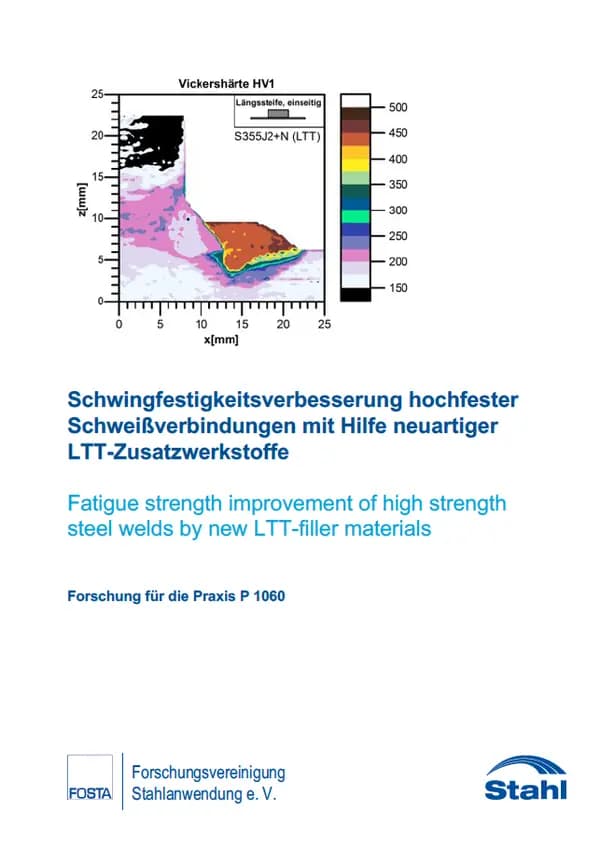
P 1060 - Improving the fatigue strength of high-strength welded joints with the aid of novel LTT filler materials

P 1060 - Improving the fatigue strength of high-strength welded joints using innovative LTT filler materials The use of LTT filler materials represents an alternative approach to the usual methods of post-weld treatment …

Content

Publication
April 2020
Authors
Prof. Dr Thomas Kannengießer, Dr Arne Kromm, Dipl.-Ing. Jonny Dixneit, Prof. Dr Klaus Dilger, Dr Thomas Nitschke-Pagel, Dr Jonas Hensel, Dipl.-Ing. Hamdollah Eslami

P 1060 - Improving the fatigue strength of high-strength welded joints using innovative LTT filler materials The use of LTT filler materials represents an alternative approach to the usual methods of post-weld treatment for increasing the fatigue strength of welded steel structures. The main mechanism of action is based on influencing the residual stress state through the low martensite start temperature during welding. As a result, the residual compressive stresses from the impeded volume expansion due to phase transformation become fully effective. Furthermore, the weld seam has a high hardness, which can delay the formation of fatigue cracks, but also leads to a low impact energy.

Show full description

In this research project, fundamental investigations were carried out into the welding processing of an LTT filler material. This includes ensuring weldability and characterising the joint properties. Investigations into weldability made it clear that safe use is possible within the working window available for high-strength steels. The Cr-Ni-based LTT filler used can be joined with a high seam quality. The mechanical properties also allow it to be used in the area of high-strength steels with a yield strength of 960 MPa. There is potential for development in terms of toughness. The notched impact values achieved in this work are significantly lower than those of commercially available conventional weld metals. The investigations show that the effect of the martensitic phase transformation comes into play in the entire weld metal. The desired high residual compressive stresses are primarily found in the weld metal interior. In the next step, fatigue strength tests were carried out on the steels S355J2 and S960Q using conventional filler materials in comparison to the LTT filler. The design details used are a butt joint with variation of the weld seam design (DY seam and V-seam), a cross joint with HV seam and a lap joint with fillet welds on one and both sides. In addition, a specimen similar to a component (the longitudinal stiffener) was analysed in which the LTT filler material was applied as an additional welded layer. In addition to the fatigue strength, the weld seams were characterised in terms of residual stresses, residual stress stability in the fatigue test and metallographically. A generally positive effect of the LTT filler material with regard to the increase in fatigue strength cannot be confirmed. In some cases, an increase in fatigue strength can be observed when conventional filler materials are substituted, in other cases there is no effect. The reason for this is the lack of stiffness transverse to the weld seam in some joint shapes, which would be necessary for the formation of high residual compressive stresses due to phase transformation. However, the component-like longitudinal stiffness confirms the fundamental potential of the LTT filler materials if sufficient stiffness is present.
P 1060 - Improving the fatigue strength of high-strength welded joints with the aid of novel LTT filler materials
Zum Zoomen hovern
€30.00excl. VAT

Payment by card (Stripe) or invoice (DE, AT, CH). Download link by email: automatically after ordering by card, after order approval for invoice (valid for 30 days). Terms

P 1060 - Improving the fatigue strength of high-strength welded joints with the aid of novel LTT filler materials—
€30.00
Machine-translated title and description. The document itself is in German.

What's included

✓

Digital download

Similar documents

Other parts and editions as well as neighbouring documents of the same series.

  • Thumbnail
    FOSTA

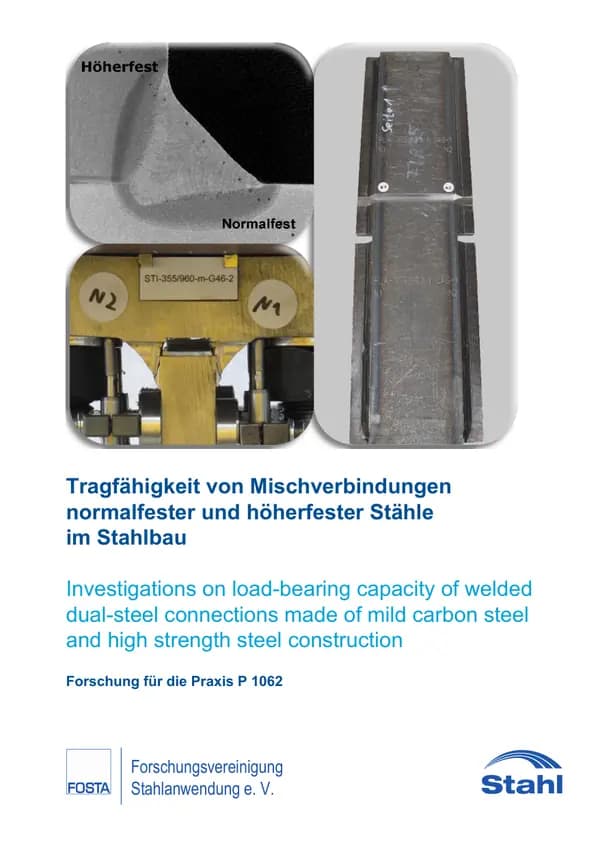
    P 1062 - Load-bearing capacity of mixed joints of normal-strength and high-strength steels in steel construction

    P 1062 - Load-bearing capacity of mixed connections of normal-strength and higher-strength steels in steel construction The requirement for filigree constructions with high stresses consequently leads to the use of higher-strength steels. In addition to questions of stability and fatigue, the connection and joining options are also decisive for their use. The procedure for mixed connections is open, i.e. when higher-strength S690 steels are connected to normal-strength S355 steels, for example. This is a situation that occurs as standard in practice because the choice of steel is usually adapted to the utilisation and there are always attachments with lower stresses. Current design concepts in EN 1993-1-8 for fillet welded joints do not take the strength of the weld metal into account. Also, mixed joints are currently to be designed according to the higher-strength steel with regard to the weld material, but may only be calculated with the values of the normal-strength base material. The aim of the research project is to check the applicability of the already adapted design model for fillet welds of the same base materials and to develop a realistic and comprehensible design model to determine the load-bearing capacity of hybrid welded joints with fillet welds made of normal-strength and higher-strength structural steels for use in steel construction and related areas (plant and crane construction). The aim is to improve the load-bearing capacity of fillet welds in hybrid joints in the current steel construction standards. Future consideration of the welding filler material in combination with the different base materials to be joined should enable a suitable selection of the optimum combination of load-bearing capacity, toughness and deformability. Component tests are carried out to characterise the load-bearing capacity and deformation of mixed joints and comprehensive material tests to determine the mechanical properties. Based on the correlation between component tests and mechanical properties, a detailed statistical analysis of the results was carried out. Based on the evaluation of the experimental test results and the results of the statistical analysis, the applicability of the adapted design model according to Rasche [7] was confirmed. The results were summarised in recommendations which, on the one hand, cover the design and welding of dissimilar joints for practical use and, on the other hand, provide design rules which can be forwarded to the CEN committees as a proposed standard via the German mirror committee. Publication date: April 2019 Authors: Prof. Dr.-Ing. U. Kuhlmann, J. Spiegler, M.Sc.

    available anytime

    €40.00

    excl. VAT

    View details →
  • Thumbnail
    FOSTA

    P 1063 - Tribosystem optimisation in the forming of complex components made of iron-manganese steels with TWIP effect

    P 1063 - Tribosystem optimisation in the forming of complex components made of iron-manganese steels with TWIP effect Iron-manganese steels with TWIP effect have been proven to have a very advantageous property profile, especially with regard to mechanical properties and forming behaviour. The special properties make this new class of materials very attractive in industrial terms. Due to the high level of strength combined with high ductility, iron-manganese steels are extremely interesting not only for non-automotive applications but also for applications in crash-relevant automotive body structures.Modern lightweight construction concepts can benefit greatly from iron-manganese steels (FeMn), as component consolidation can save a considerable amount of vehicle mass and therefore fuel. Furthermore, cold-formable FeMn steels offer potential as an alternative to hot-formed components. The aim of this research project was to make the forming potential of iron-manganese steels with TWIP effect accessible to users in practice for the production of geometrically complex, high-strength components. The aim of the research project was to expand the process window. This objective was to be achieved by optimising the tribological conditions of both forming processes, with strip drawing tests in various designs representing different contact conditions and process temperatures forming an essential part of the experimental investigations. The corresponding test equipment was modified for this purpose, in particular to reproduce a temperature field similar to that in series production. In the test series, a dependency on the oiling condition was determined, which differs in part from the behaviour of conventional steel grades. In further deep-drawing tests, in addition to a clear dependence of deep-drawing properties on the forming lubricant used, the optimisation potential of tool cooling was also validated. The deep drawability of test components made of FeMn was positively influenced by lowering the mould temperature, almost independently of the lubricant used. Authors: B.-A. Behrens, C. Gaebel, M. Micke-Camus, D. Yilkiran, C. Pfeffer Publication: 2018

    available anytime

    €30.00

    excl. VAT

    View details →
  • Thumbnail
    FOSTA

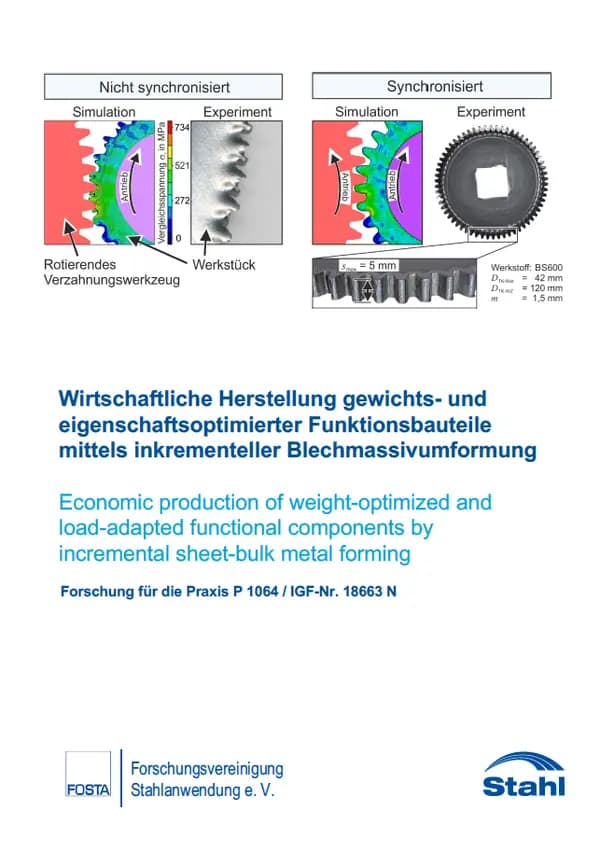
    P 1064 - Economical production of weight- and property-optimised functional components by means of incremental sheet metal forming

    P 1064 - Economical production of weight- and property-optimised functional components by means of incremental sheet metal forming The objective of the research project is the economic production of industrially relevant functional components using incremental sheet metal forming. A defined edge thickening of sheet metal blanks and subsequent embossing of serrations are to be investigated. By using suitable materials, the work will focus on the targeted utilisation and maximisation of work hardening. In co-operation with the partners, the aim is to significantly reduce the machining time. Based on the current status of the incremental approach, this must be greatly reduced and brought closer to realistic cycle times. The process acceleration required for this involves changes to the thermal process conditions, which are to be investigated as part of this research project. Using new strategies, the effects on the specifically adjustable component properties are to be determined experimentally and numerically so that subsequent heat treatment can be dispensed with in order to save costs and avoid the associated negative aspects. The challenge is to maximise the material-dependent effect of work hardening and to optimise it for a possible industrial application. The disadvantageous aspects of conventional production are to be avoided by shaping close to the final contour and optimising the use of the material and its work hardening. There are fundamental challenges for the complex process with cyclical loading and unloading with mutual influence of the process parameters. These relate to the prevailing tool load, the process parameters to be set and the entire tribological system, which requires the use of new tool steels and suitable lubricant technology. The main focus of the investigations is to determine and control the resulting conflict of objectives with regard to the forming temperature due to the accelerated process control and the targeted work hardening. Publication date: August 2020 Authors: Prof. Dr.-Ing. Dr.-Ing. E.h. A. E. Tekkaya, Dr.-Ing. P. Sieczkarek, Dr.-Ing. S. Gies, S. Wernicke M. Sc.

    available anytime

    €30.00

    excl. VAT

    View details →
  • Thumbnail
    FOSTA

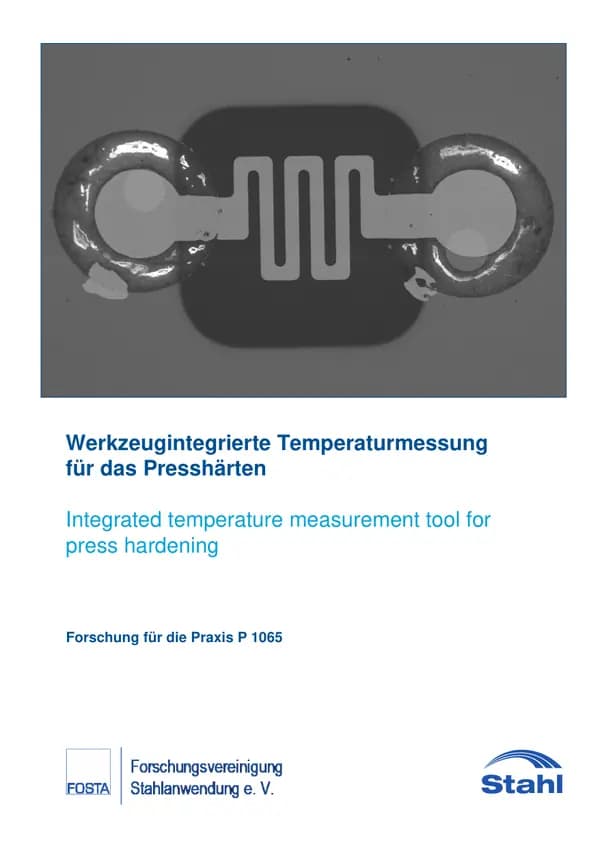
    P 1065 - Tool-integrated temperature measurement for press hardening

    P 1065 - Mould-integrated temperature measurement for press hardening If deviations from the designed mould hardening process are not reliably detected, this can lead to the processing of defective components in the further process chain. This can result in considerable follow-up costs. Sensors integrated into forming tools make it possible to detect any temperature irregularities and initiate countermeasures at an early stage. Furthermore, varying cooling rates during the production cycle, caused by fluctuations in the tool temperature, can be used as an input signal for active control of the holding time. Sensors based on thin-film technology offer the advantage of being in direct contact with the semi-finished product without reducing the component quality due to thermal interference. This means that the component can be monitored during the production process and manufactured without errors. Due to the increasing complexity of forming processes and production close to the process limit, these sensors offer great potential for reducing the number of rejects produced and cycle times. This enables the production process to be organised more economically and contributes to the resource-saving use of raw materials. The aim of this research project was to develop a tactile thin-film temperature sensor for direct use in forming tools. In order to ensure an economical service life of the sensors, investigations were first carried out to identify a suitable wear protection layer, with a layer of Al2O3 showing the best results. At the same time, processes for the production of thermoelectric and thermoresistive sensor coatings were developed. The sensor concepts were calibrated taking into account different forming tool temperatures. The thermoresistive sensor in particular showed good agreement in the temperature range up to 400 °C in comparative measurements. This allows the component to be monitored in the production process and ensures the further processing of a defect-free component. The IGF project 18338 N of FOSTA-Forschungsvereinigung Stahlanwendung e. V., Düsseldorf, was funded via the AiF as part of the programme to promote joint industrial research (IGF) by the Federal Ministry for Economic Affairs and Energy on the basis of a resolution of the German Bundestag. The project was carried out by the Institute of Forming Technology and Forming Machines and the Institute of Microproduction Technology, Gottfried Wilhelm Leibniz University of Hanover. Publication: January 2019 Authors: Prof. Dr.-Ing. B.-A. Behrens, Dipl.-Ing. Ch. Pfeffer, Dipl.-Ing. D. Yilkiran, Prof. Dr.-Ing. L. Rissing, F. Dencker M.Sc., Dipl.-Ing. M. Stompe

    available anytime

    €20.00

    excl. VAT

    View details →
€30.00excl. VAT

Payment by card (Stripe) or invoice (DE, AT, CH). Download link by email: automatically after ordering by card, after order approval for invoice (valid for 30 days). Terms

P 1060 - Improving the fatigue strength of high-strength welded joints with the aid of novel LTT filler materials—
€30.00