The increasing demands in the passenger car sector for safety, comfort and driving performance have led to a continuous increase in vehicle weight in recent years. In order to achieve further development in the area of …
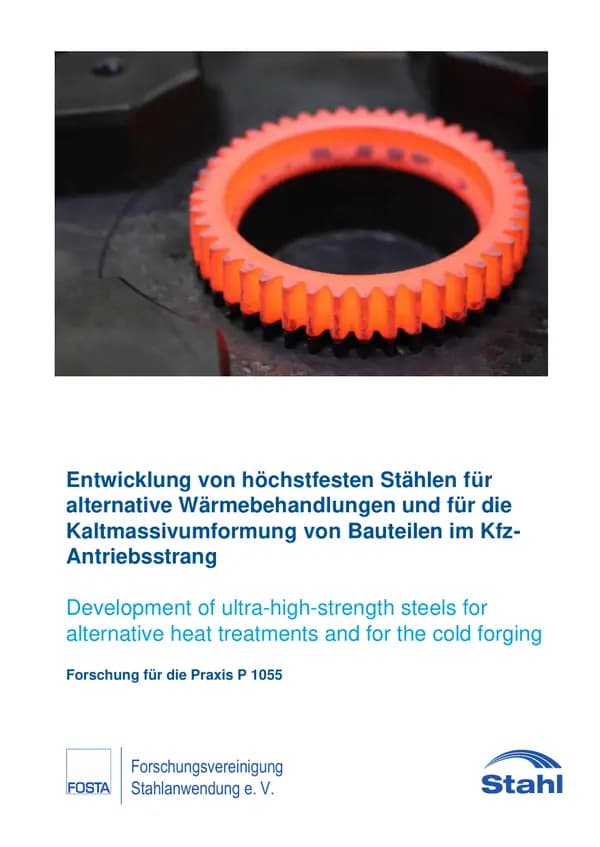
The increasing demands in the passenger car sector for safety, comfort and driving performance have led to a continuous increase in vehicle weight in recent years. In order to achieve further development in the area of driving dynamics in the future while at the same time reducing CO2 emissions and fuel consumption, this trend must be countered by new lightweight construction measures. Based on the current state of the art, approaches are being pursued in the field of material and structural lightweight construction as well as lightweight production and concept construction. As part of this research project, new steels and/or an adapted heat treatment for components used in the powertrain were developed.
The focus was on lightweight material construction. According to a study by the Institute for Automotive Engineering at RWTH Aachen University (ika), approx. 1/3 of lightweight construction ideas for the powertrain are based on lightweight material construction. This study also identified the problem that, in many cases, measures in the field of lightweight material construction are usually directly linked to other measures in the field of lightweight design or lightweight manufacturing. The very high costs associated with this have so far led to major obstacles to the implementation of these lightweight material construction approaches. In this research project, this problem was addressed in co-operation with other sub-projects. An initial focus here was on the development and optimisation of steels with a higher load-bearing capacity for lightweight applications in the drivetrain. To this end, the chemical composition and heat treatment of case-hardening and heat-treatable steels already used on an industrial scale were modified in such a way that the potential of their property profile is utilised to a far greater extent than before. Furthermore, with a focus on large-scale realisation, new material concepts were specifically adapted to the promising heat treatment process of carbonitriding by means of microalloying, which lead to a higher component load-bearing capacity and thus have an increased lightweight construction potential. The lightweight construction potential was assessed using the gear component in extensive experimental load-bearing capacity tests. The second focus of the research project was to increase the lightweight construction potential of drivetrain components in conjunction with lightweight manufacturing. Of particular interest here is the cold forging of steels with a high forming capacity, which are more cost-effective than lighter aluminium alloys and have the required high basic strength. In order to ensure a reduction in production costs, subsequent heat treatment should be dispensed with. Newly developed but not yet commercially available materials with higher formability for cold forging were therefore optimised in terms of their property profile and manufacturing process. Participating companies: ArcelorMittal Hochfeld GmbH, Bharat Forge CDP GmbH, Bodycote Wärmebehandlung GmbH, BorTec GmbH, Daimler AG, Deutsche Edelstahlwerke GmbH, EZM Edelstahlzieherei Mark GmbH, Felss Systems GmbH, fischerwerke GmbH & Co. KG, Georgsmarienhütte GmbH, GKN Driveline Trier GmbH, HAMMERWERK FRIDINGEN GmbH, Hanomag Lohnhärterei GmbH, Härterei Tandler GmbH & Co. KG, Heess GmbH & Co. & Co. KG, Hirschvogel Umformtechnik GmbH, Johann Hay GmbH & Co .KG, LechStahlwerke GmbH, Mannesmann Precision Tubes GmbH, Opel Automobile GmbH, Räuchle GmbH + Co. KG, RENK Aktiengesellschaft, Robert Bosch GmbH, Rohde Schutzgasöfen GmbH, Rohrwerk Maxhütte GmbH, Saarstahl AG, Salzgitter Mannesmann Forschung GmbH, Schaeffler Technologies AG & Co. KG, Sidenor SA, SKF GmbH, Swiss Steel AG, Vallourec Deutschland GmbH, Vestas Nacelles Deutschland GmbH, voestalpine BÖHLER Edelstahl, Volkswagen AG, ZF Friedrichshafen AG Research institutes: Institute of Ferrous Metallurgy, RWTH Aachen University Leibniz Institute for Materials-Oriented Technologies - IWT, Bremen FZG - Research Centre for Gears and Transmission Engineering, TU Munich
Payment by card (Stripe) or invoice (DE, AT, CH). Download link by email: automatically after ordering by card, after order approval for invoice (valid for 30 days). Terms
Machine-translated title and description. The document itself is in German.
Digital download
Other parts and editions as well as neighbouring documents of the same series.

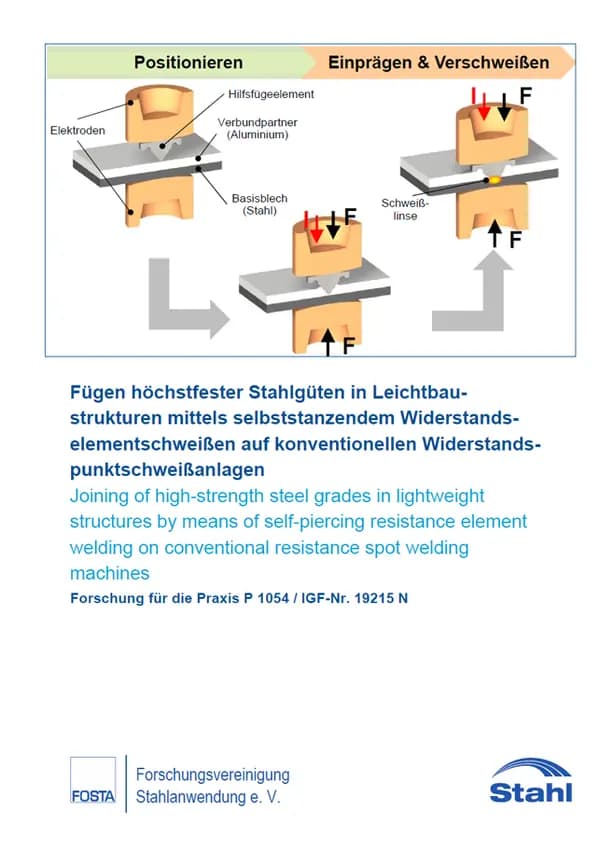
P 1054 - Joining high-strength steel grades in lightweight structures by means of self-piercing resistance element welding on conventional resistance spot welding systems The aim of the research project is to develop a new type of resistance element welding process (WES) for joining ultra-high-strength steels in combination with dissimilar materials. In contrast to the current state of the art, a single-stage process and thus the use of conventional resistance welding technology is planned for both the insertion and welding of the auxiliary joining parts. The realisation of the results obtained will make an important contribution to the further development of resistance element welding and the economic production of future steel-intensive lightweight structures in mixed construction. The kmU user group includes, in particular, system manufacturers of element and feeding technology, suppliers of connecting elements and suppliers of resistance welding technology and automation technology. The high probability of short-term integration of the process into existing production processes due to low investment costs opens up numerous new business and application areas for these SMEs. Overall, this creates a direct benefit for SMEs by offering flexible and innovative joining solutions, which helps their customers to manufacture mixed structures cost-efficiently. In the research project, process principles were developed that characterise the mechanical and technological properties of single-stage joined WES joints and the joining process. The development of punchable, cold-formable and simultaneously weldable auxiliary joining part geometries and the definition of process parameters for optimal joint formation are milestones in this regard. Another milestone is the derivation of application guidelines as well as design and production instructions based on a preceding parameter influence analysis to determine systematic influencing and disturbance variables on the joining process. The research results achieved contribute to the process expansion of resistance welding technology and demonstrate a possibility that enables the joining of steel-intensive sheet metal structures in combination with thin aluminium sheets and adhesives. The assemblies can be produced economically, in line with cycle times and with relatively low investment costs. The efficiency of resistance welding technology combined with the outstanding properties of ultra-high-strength and ultra-high-strength steels allows the production of weight-optimised and rigid passenger cells in mass production, as both the choice of material and the choice of joining technology are economically advantageous. The advancing development of ultra-high-strength high-performance steels (3rd generation steels) and the increasing trend towards mixed construction emphasise the need for cost-efficient joining solutions. Publication date: November 2020 Authors: Prof. Dr.-Ing. G. Meschut, M. Sc. H. Günter
available anytime
€30.00
excl. VAT

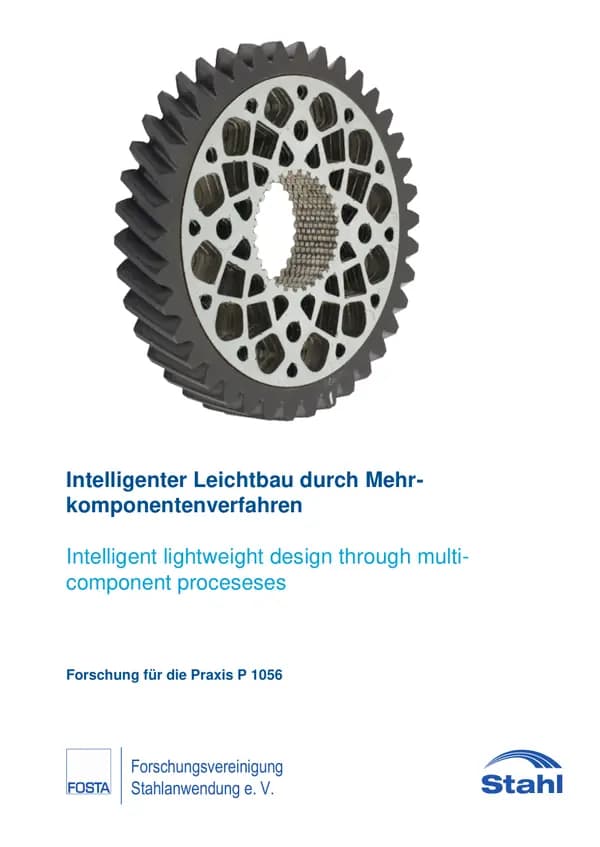
P 1056 - Intelligent lightweight construction through multi-component processes The weight of drivetrain components has been continuously reduced through stress-optimised design and the resulting material savings in areas subject to low loads. With a consistent increase in power density and the associated reduction in weight, there is further potential for the intelligent lightweight construction of drivetrain components in the future. A holistic view of the design of the component, the material, the heat treatment and the manufacturing and joining processes used offers particular potential. By combining different manufacturing processes and materials, the various requirements of different component areas can be specifically fulfilled. This makes it possible to achieve a load-appropriate and cost-effective lightweight construction. Based on the multi-component construction method, solutions are developed to integrate solid individual components into overall structures. For example, higher-strength components made of steels with increased load-bearing capacity and optimised heat treatment operations open up additional fields of application for components produced using forming technology. High power density and lower component weight are achieved in gears built in this way by using a high-strength steel for a gear rim with the highly stressed toothing, which is combined with a wheel body in lightweight construction. lightweight construction. The wheel centre can be manufactured from high-strength sheet metal materials with a very low weight. Very light wheel centres with thin wall thicknesses are achieved by deep drawing. In addition, a weight saving is achieved during the packaging of sheet metal blanks by designing the spoke shape to withstand the stresses. The production of wheel bodies using forming technology also allows the positive and/or frictional joining of the spider, wheel body and shaft, thus enabling a compact, weight-optimised design. The thermal joining of an interference fit between the case-hardened ring gear and wheel centre can be carried out efficiently through the targeted use of temperature differences directly during quenching. Selected prototypes are examined with regard to functional behaviour and durability. The advantage of a design built in this way (differential design) over an integral design lies in the combinability of optimised processes for the production of individual components designed to withstand stresses. The individual component-related processes allow the respective processes to be optimised without having an unwanted influence on the other components, for example through integral heat treatment. FOSTA - Research Association for Steel Application e. V. February 2020 Participating companies: BMW Group, BorTec GmbH, CARL BECHEM GmbH, Daimler AG, Deutsche Edelstahlwerke, Faurecia Autositze GmbH, Georgsmarienhütte GmbH, GKN Driveline Trier GmbH, Hanomag Lohnhärterei GmbH, Härterei Tandler GmbH & Co. KG, Heess GmbH & Co. KG, HOERBIGER Antriebstechnik GmbH, Lindauer DORNIER GmbH, Mac Panther GmbH, Max Aicher Stiftung, MTU Friedrichshafen GmbH, Opel Automobile GmbH, Räuchle GmbH + Co. KG, RENK Aktiengesellschaft, Robert Bosch GmbH, Rohde Schutzgasöfen GmbH, Rohrwerk Maxhütte GmbH, Schaeffler Technologies AG & Co. KG, SEISSENSCHMIDT GmbH, Sidenor SA, SKF GmbH, Stelter Zahnradfabrik GmbH, SynOpt GmbH, thyssenkrupp Hohenlimburg GmbH, thyssenkrupp Steel Europe AG, TIME Technologie-Institut für, Vallourec Deutschland GmbH, Vestas Nacelles Deutschland GmbH, Volkswagen AG, ZF Friedrichshafen AG Research institutions: Institute for Forming Technology, University of Stuttgart Chair of Forming Technology and Foundry Engineering, TU Munich FZG - Research Centre for Gears and Transmission Engineering, TU Munich Leibniz Institute for Materials-Oriented Technologies - IWT, Bremen
available anytime
€40.00
excl. VAT

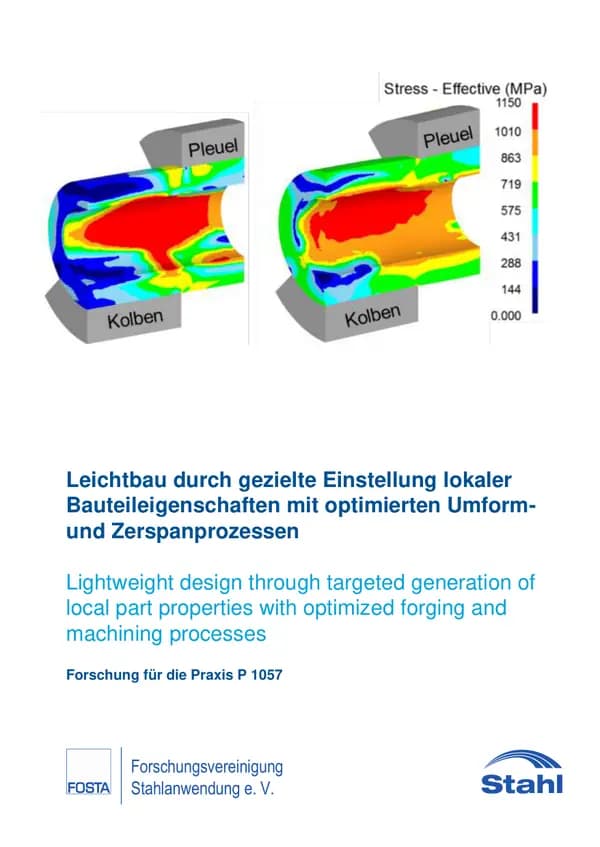
P 1057 - Lightweight construction through targeted adjustment of local component properties with optimised forming and machining processes The project aims to close the existing gap between the definition of requirements for local component properties, in particular with regard to work hardening, residual stresses and stress-appropriate fibre flow, and the assurance of these properties through optimised forming and machining processes. The development of steel materials with process-appropriate properties (cold formability, yield stress, hardening, machinability) is also considered. A further aim of this sub-project was the development of an efficient efficient methodology for the virtual design of robust forming and machining processes to achieve optimum local component properties. Usually, only a homogenised increase in material strength as a result of cold forming is assumed with sufficient certainty and lightweight construction potential is exploited from this. Local strength properties of cold-formed workpieces as well as residual stresses and, in particular, the fibre orientation are often insufficiently taken into account in component and forming process design and subsequent machining processes. In this sub-project, lightweight construction potentials for cold-formed components were investigated through the targeted adjustment of local component properties with optimised forming and machining processes. To this end, a methodology was developed for the efficient CAE-based design of optimised and robust cold extrusion and downstream machining processes for the economical production of lightweight components. In the cold extrusion of steel components, an improved prediction of the mechanical material properties as a result of work hardening and residual stresses can be achieved. Due to the more precise property determination and adjustment, lighter components can be designed. Similar deficits exist in the development of steel materials. Following the process chain, the local component properties were first modelled during cold extrusion using FEM forming simulations and then during subsequent machining. The previous results were recorded in a structural-mechanical FEM simulation and the load direction-dependent component properties were determined. The findings of these three simulation packages were subsequently used for the integration into a CAE-based design of optimised and robust process chains. Two demonstrator components (gear hub and piston pin) were developed using this methodology to demonstrate the lightweight construction potential. A mould was constructed for the gear hub and a gear was manufactured based on TP2. Finally, the results obtained were used to carry out economic analyses with regard to machining as well as technological component tests to determine the lightweight construction potential and lightweight construction costs. Publication: February 2020 Participating companies: CARL BECHEM GmbH, Daimler AG, Deutsche Edelstahlwerke, DYNARDO GmbH, EZM Edelstahlzieherei Mark GmbH, Fastenrath Befestigungstechnik GmbH, Felss Systems GmbH, fischerwerke GmbH & Co. KG, Georgsmarienhütte GmbH, GKN Driveline Trier GmbH, Gühring KG, HAMMERWERK FRIDINGEN GmbH, Hermann Bilz GmbH, Mahle GmbH, Max Aicher Stiftung, Metal Improvement Company Inc. Surface Technologie, Opel Automobile GmbH, Räuchle GmbH + Co KG, Robert Bosch GmbH, Rohrwerk Maxhütte GmbH, Saarstahl AG, Schaeffler Technologies AG & Co KG, Seco Tools GmbH, SEISSENSCHMIDT GmbH, Sidenor SA, SMS Group GmbH, Swiss Steel AG, SynOpt GmbH, thyssenkrupp Presta AG, Vestas Nacelles Deutschland GmbH, Volkswagen AG
available anytime
€40.00
excl. VAT

P 1052 - Systematic investigation of the load-bearing and failure behaviour of bonded steel-glass joints As part of the research project, the load-bearing and failure behaviour of structural bonded joints in glass façade construction was investigated. Initially, the parameters of the actions were systematically analysed. This primarily included the allocation of the magnitudes of the stress velocities to the decisive effects of temperature and wind, the frequency of the joint occurrence of air humidity and air temperature as well as the bearing reactions of typical SG glazing. Furthermore, the substrate surfaces considered within the scope of the project were analysed and the material behaviour of the adhesive materials to be investigated was characterised. All investigations were carried out on two different 2C silicone adhesives and a high-performance adhesive tape. Among other things, the influence of different strain rates was determined. The strain rate-dependent working curves in the tensile and tensile shear experiments can be used to calibrate material models. Furthermore, various parameters influencing the load-bearing behaviour were investigated on joint-like samples with different cross-sections. Four different cross-sections with different edge ratios were selected for the two silicone adhesives; two different adhesive tape widths were selected for the high-performance adhesive tape. The joint-like test specimens were destructively tested under different load directions (tension, diagonal tension at 45°, transverse and longitudinal shear). Experimental tests at different temperatures (-20°C, +80°C) supplemented the test programme. The influence of ageing, the load rate and the creep and relaxation behaviour were also investigated. The influence of the joint geometry and the parameters influencing the load-bearing behaviour form a new basis for evaluation on the basis of which the current method of determining characteristic values in accordance with ETAG002 can be discussed and successively adapted to real dimensions. The experimentally determined load-bearing behaviour of the joint could be mapped with the aid of numerical simulations for individual test series. The simulation of discontinuous joints, which can occur as a result of local overstressing, has shown that the system is able to compensate for these as far as possible. Plotting the parametrically determined nominal strengths in tension-shear interaction diagrams allows the multiaxial description of the limit of load-bearing capacity. This then forms the basis for the definition of an empirically calibrated load-bearing capacity criterion, which can be transferred to a design model using characteristic values and partial modification factors. Accompanying considerations on suitable methods of adhesive joint monitoring for monitoring under long-term stress complete the research project. Publication: 2017 Authors: Prof. Dr T. Ummenhofer, Prof. Dr Ch. Schuler, Prof. Dr B. Mayer
available anytime
€30.00
excl. VAT
Payment by card (Stripe) or invoice (DE, AT, CH). Download link by email: automatically after ordering by card, after order approval for invoice (valid for 30 days). Terms