Stainless steels are often used in the design of ventilated metal façades. They impress with their characteristic appearance and high durability. However, challenges arise with large-area façade elements. High rigidity …
Stainless steels are often used in the design of ventilated metal façades. They impress with their characteristic appearance and high durability. However, challenges arise with large-area façade elements. High rigidity requires greater material thicknesses and higher resource consumption. Increasing material thickness limits the individual design of the façade elements. The current requirements in modern façade design intensify this challenge. Individually shaped, three-dimensional façade elements with sharp-edged contours or organic free-form surfaces with soft transitions between individual moulded elements are often desired.
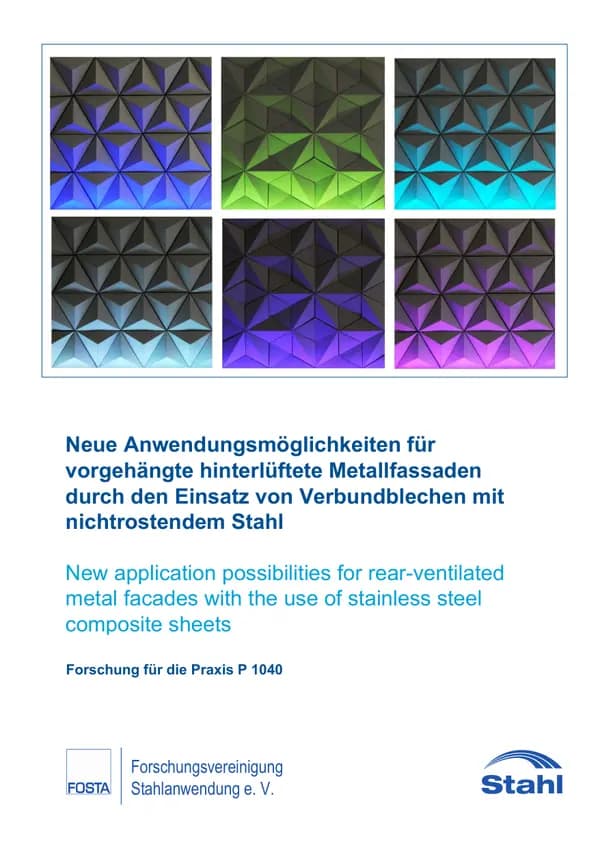
The solution approach chosen in this research project addresses the realisation of these requirements and tests the use of new composite sheets with stainless steel for ventilated curtain wall façades. The composite sheet allows shaping with lower forming forces while maintaining the same rigidity, and its own weight is also significantly lower. Following a basic characterisation of the material, evidence is provided for the use of typical joining, cutting and forming processes. The possibility of using other forming processes, such as the milling edge technique for composite sheets with stainless steel, is also positively demonstrated. Another result is a catalogue of possible element geometries, as well as a presentation of the effect of static strengthening through component folding. The realisation of pneumatic stretch forming as a new forming process for the design of façade sheets is successfully implemented, and current requirements in façade construction are given additional design potential as a result. As proof of feasibility, a demonstrator was created to show the potential of the composite sheet as a façade sheet. An additional innovative side effect is the option of inserting welding studs, which allow the panels to be fastened on the back and concealed. To summarise, the composite sheet investigated represents a very good alternative to elements made of single-layer metal panels for the design of rear-ventilated metal façades. Composite sheets with stainless steel are characterised by very good formability and are also suitable for the application of established façade design methods. The research project was carried out by the Department of Architecture and Metal Construction at Dortmund University of Applied Sciences and Arts and the Institute of Production Engineering at Dresden University of Technology with technical support and funding from the Forschungsvereinigung Stahlanwendung e. V., Düsseldorf, with funds from the Stiftung Stahlanwendungsforschung, Essen.
Payment by card (Stripe) or invoice (DE, AT, CH). Download link by email: automatically after ordering by card, after order approval for invoice (valid for 30 days). Terms
Machine-translated title and description. The document itself is in German.
Digital download
Other parts and editions as well as neighbouring documents of the same series.

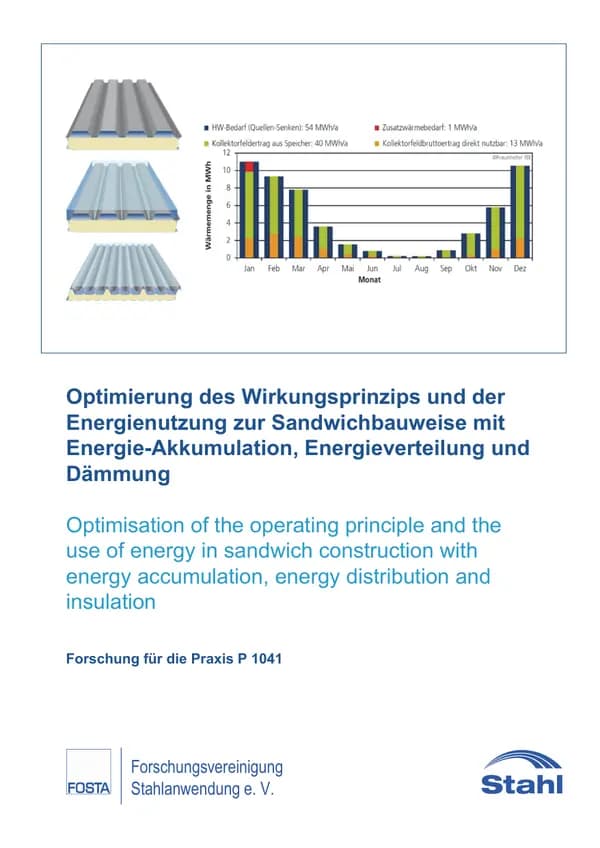
P 1041 - Optimisation of the principle of operation and energy utilisation for sandwich construction with energy accumulation, energy distribution and insulation Industrially manufactured sandwich elements with additional trapezoidal steel sheets on the outside were joined together in the FOSTA project P 779 to form the so-called SEA air collector (SEA = Sandwich Energy Accumulation). Due to the cross-section of the trapezoidal steel sheets, channels through which air can flow are created when the individual components are joined together on the outside. With solar radiation on the south façade and on the roof surface, the SEALuftkollektor can generate an annual energy yield of approx. 160 kWh/m² in the form of heated air. This project investigated the extent to which the energy yield of this collector can be further improved by optimising physical and design parameters. In order to investigate the individual optimisation aspects, a research approach consisting of measurement, simulation and calculation was chosen. Laboratory measurements were used to quantify the positive influence of a transparent cover in the form of a solid polycarbonate panel on the efficiency and temperature level of the SEA collector. Changing the profile geometry of the absorber and adapting various design aspects to increase heat transfer also proved successful. Ultimately, this resulted in an aesthetically pleasing collector in which all variants continue to fulfil the principle of using only components that are available on the market as individual parts. Laboratory measurements were used to precisely clarify the mass flow dependency for the analysed collectors and efficiency curves were generated for three SEA collector variants. The accompanying simulation and calculations were used to show the range of optimum air duct heights for flat or trapezoidal absorbers, how the angle of incidence, different degrees of absorption and the collector lengths affect the efficiency and temperature level of the collectors. Finally, a sample hall was used to show the contribution that collectors can make to the energy utilisation concepts of heating and cooling using different system variants of secondary energy generators and the integration of an energy storage unit in an hourly-resolved annual analysis with reference weather data. With regard to cooling, for example, it was shown that even without an energy storage system, full solar coverage can be assumed. In the case of energy utilisation for heating, however, this only appears possible with the integration of an energy storage system. Publication: March 2020 Authors: Dr Michael Hermann, Timo Altan, Frederik Böhm, Sofía Camarena Covarrubias, Paolo Di Lauro, Stefan Fortuin, Muhammad Haris, Dr Korbinian Kramer, Manuel Lämmle, Axel Oliva, Max Reinhardt, Christoph Thoma, Christian Welz, Rolf Koschade, Gabriele Deisenroth-Bröcker, Donald Greiner, Klaus Pilsner
available anytime
€40.00
excl. VAT

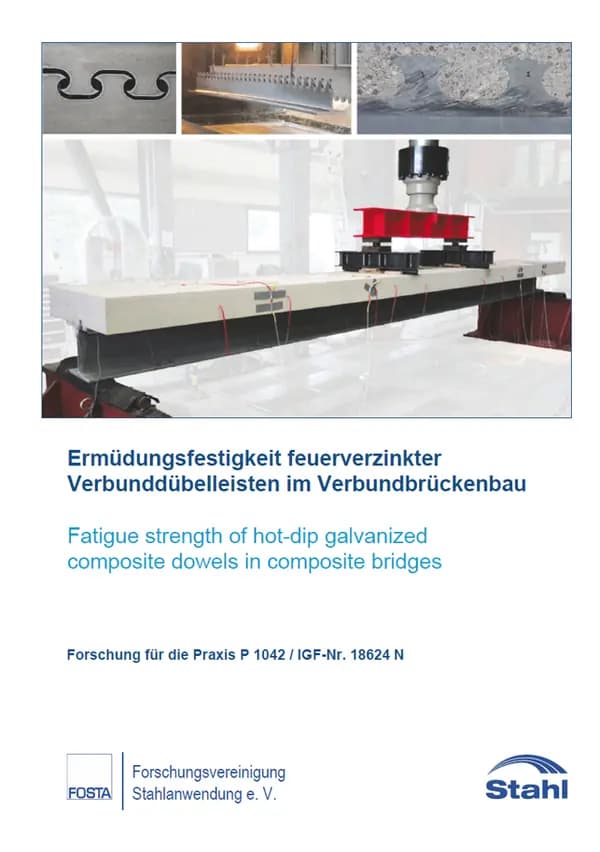
P 1042 - Fatigue strength of hot-dip galvanised composite dowel bars in composite bridge construction Studies in recent years have shown that the hot-dip galvanisation of steel components in bridge structures has economic and ecological advantages. It has been shown that the corrosion protection provided by hot-dip galvanising can last for the service life of a bridge of 100 years, even in an environment with high corrosivity, so that no major corrosion protection maintenance measures are required. At the same time, another innovative solution was developed to increase the efficiency of composite bridges. Based on several research projects and an initial application in 2003, composite dowel bars have been proven to offer an economical solution for shear connections between steel girders and concrete slabs in composite bridge structures. Continuous improvements and further developments ultimately led to FOSTA applying for a general technical approval from the DIBt in Germany. Numerous bridges using this new technology have since been built in Germany and abroad. However, hot-dip galvanising cannot yet be used for bridges with composite dowel bars, as the effects of hot-dip galvanising on the fatigue strength of flame-cut composite dowel bars are not yet known. The required verification of fatigue in accordance with DIN EN 1993-1-9 can therefore not be carried out at present. In order to be able to combine the advantages of the composite dowel bar with those of hot-dip galvanising in bridge construction, the basis for technical regulations for the use of hot-dip galvanised composite dowel bars was developed as part of this project. For this purpose, the galvanising process with the process-related and geometric influences was examined in detail with regard to possible pre-damage to the composite dowel bar. It was found that the resulting plastic strains in the most unfavourable configuration of geometry and galvanising process of a maximum of 0.5% were below the limit value of 2% specified in DASt Guideline 022, Annex 4 for the requirements of detail class A. Furthermore, the influence of hot-dip galvanising on the fatigue strength of the composite dowel bar was investigated by means of cyclic tests. Comparative fatigue tests were carried out on galvanised and non-galvanised small component samples, push-out bodies and component-like beams. The tests consistently showed that, as regulated for the non-galvanised composite dowel bar in the general design approval, the proof of fatigue strength can also be carried out for the hot-dip galvanised version with notch case 125 in accordance with DIN EN 1993-1-9. This made it possible to achieve the research objective and provide a practicable basis for design in practice. Publication: May 2020 Authors: Prof. Dr.-Ing. M. Feldman, R. Kühne, M.Sc., Prof. Dr.-Ing. D. Ungermann, S. Holtkamp, M.Sc.
available anytime
€30.00
excl. VAT

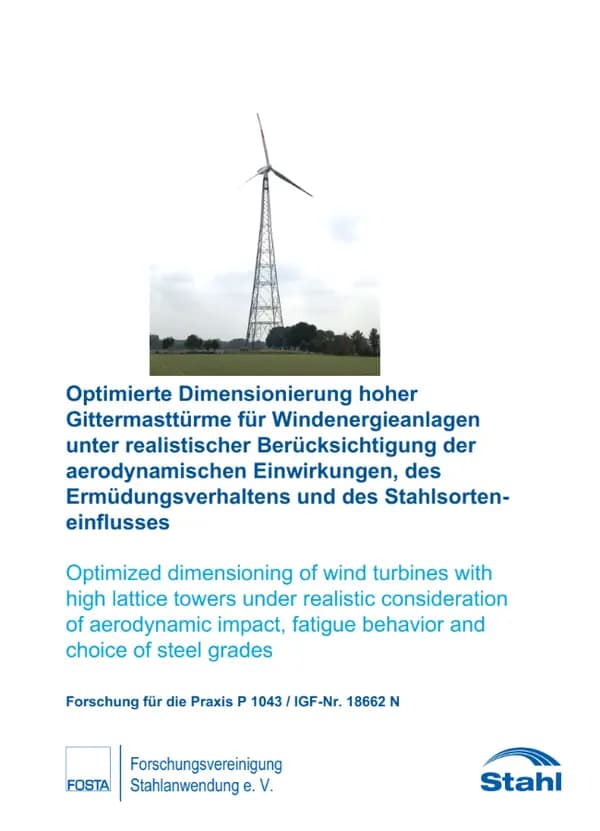
P 1043 - Optimised dimensioning of high lattice towers for wind turbines under realistic consideration of aerodynamic effects, fatigue behaviour and the influence of steel grades The research project examined fundamental aspects of the economic efficiency and optimisability of lattice towers for high towers with and without wind turbines. The work focussed on both the aerodynamic properties of lattice mast constructions and the structural aspects of this type of construction. With regard to the latter, it was in particular the topology, i.e. the geometric arrangement of the bar elements, the influence of the cross-sectional design and the steel grades used, which were varied as part of an optimisation process under economic efficiency criteria. As part of the calculations carried out, characteristic values for modelling the aerodynamic load effect in the boundary layer wind tunnel were determined, which are especially valid for the relevant high opening degrees of the lattice towers. For these investigations, models were produced that can be regarded as realistic in terms of their use with particularly high towers. In addition, the wind load effect was realistically modelled with reference to the variability of wind speed and direction. This also made probabilistic verification possible, as the load data obtained had sufficient statistical significance for the specific geometry for the first time. The verification of the structure was carried out on a completely probabilistic basis. For this purpose, the scattering variables were implemented in the calculation module. All necessary verifications were carried out on the basis of the current Eurocode standardisation. The load situation induced by the utilisation as a wind turbine is particularly challenging for the structural design of lattice towers. On the one hand, the highly dynamic load inputs must be determined by means of a correspondingly valid load calculation and, on the other hand, modelled in a suitable form with a view to the structural response. This usually requires time-based calculation methods (multi-body simulation, time-step calculation). Such load calculations were calculated for the defined reference system and the associated lattice tower using recognised calculation tools. Due to the high calculation effort, caused by the time calculation and the complexity of the structure, it was also investigated to what extent simplified spectral-based methods could be advantageous. The result showed that this can only be considered for preliminary design, but this has already proven to be advantageous in the context of the iterative optimisation process. Finally, optimisation calculations were carried out using the aforementioned tools in order to evaluate which tower and cross-section geometries and steel grades are advantageous from an economic point of view. Various calculation examples showed that the use of a higher-strength steel grade S460 compared to S355 offers significant savings potential for the particularly high towers. Publication: January 2021 Authors: Univ.-Prof. Dr.-Ing. M. Feldmann, Prof. Dr.-Ing. F. Kemper, Dipl.-Ing. M. Friehe, Prof. Dr.-Ing. R. Schelenz, Dipl.-Ing. A. Werkmeister
available anytime
€30.00
excl. VAT

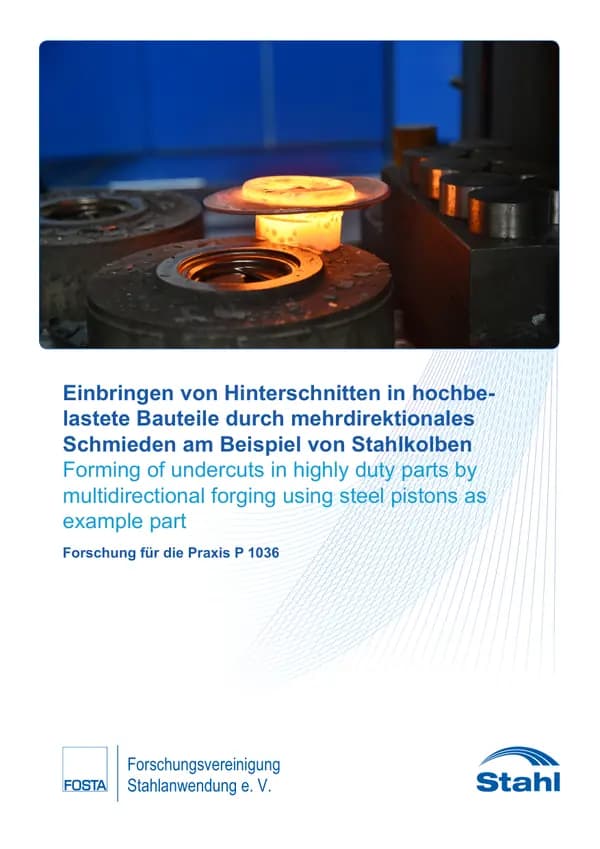
P 1036 - Introduction of undercuts in highly stressed components by multidirectional forging using the example of steel pistons In this AiF project (IGF No. 18162 N), undercut forging was investigated using the example of piston pin bores for steel pistons. In contrast to the conventional forging process for steel pistons, multi-directional forming takes place in the final forming stage, in which the piston pin bores, which represent an undercut, are preformed. To this end, the sequence of stages was first developed virtually with the aid of material flow simulations. A tool concept was then developed to enable undercut forging using a multi-directional tool. With this tool, punches move laterally into the workpiece and deform it further. This tool was designed and manufactured. Various forging tests were then successfully carried out and analysed. The economic efficiency of the process was then assessed and an application guide for the development of undercut forging processes was developed. In this project, the bolt holes in a steel piston could be pre-punched in the forging process for the first time. The advantages of this process are the material savings, improved component properties of the forged part and a faster and simplified reworking process compared to the conventional forging process. The material saving was 5% compared to the standard forging process. The adapted fibre flow in the bore area is likely to be of great importance for the component properties. From an economic point of view, the possibility of accelerated reworking through undercut forging is of the highest relevance. The design of the undercut forging process differs from conventional closed-die forging processes only in the final forming stage. It turned out that the complete punching of the component is associated with too much effort in terms of process technology, so that the pre-punching variant was favoured. The clamping forces required for multi-directional undercut forging are a particular challenge for undercut forging tools. The variants of a force-fit (using springs) and a form-fit closure (using toothing) were investigated. Due to the lower design and production costs, the design of the non-positive locking variant was pursued further. Nevertheless, the positive locking variant promises advantages, as previously impossible forging geometries can be realised, so that future investigations in this direction appear promising. The tests showed that both the retracting and extending movements of the lateral punches require high forces. In particular, the return movement of the plungers requires correspondingly 20 kN must be taken into account and the tools must be dimensioned accordingly. The evaluation of the forging results showed that the forgings were well formed in the undercut area. The fibre flow of the pistons in the bore area turned out to be very favourable and confirmed the simulations carried out previously. Due to a reduced notch effect, more favourable fatigue strength properties can be expected for bores produced using undercut forging. The undercut forging process was used in this project for the insertion of piston pin bores. In general, the process is suitable for introducing a wide variety of undercut geometries into workpieces during forging processes. Publication: 2018 Authors: M. Stonis, J. Ross
available anytime
€30.00
excl. VAT
Payment by card (Stripe) or invoice (DE, AT, CH). Download link by email: automatically after ordering by card, after order approval for invoice (valid for 30 days). Terms