The joining of steel-aluminium joints, particularly in the transport industry, is mainly carried out using mechanical joining processes and adhesive bonding. Magnetic pulse technology (MPT) represents an alternative to …
The joining of steel-aluminium joints, particularly in the transport industry, is mainly carried out using mechanical joining processes and adhesive bonding. Magnetic pulse technology (MPT) represents an alternative to conventional methods. Developments in magnetic pulse welding (MPS) to date have focused on aluminium-copper joints or low-alloy or unalloyed steel-aluminium joints. Statements on the mechanical joining properties are insufficient or in some cases not available. Based on the state of the art, the weldability of selected steel-aluminium joints has been investigated. In addition to this, surface pre-treatment was used in order to illustrate the potential of the process.
Both high-strength and ultra-high-strength steel alloys were used. Alloys from the 5xnn, 6xnn and 7xnn series were used for the aluminium alloys. After investigating the basic feasibility of different steel-aluminium joints, statistically significant test series were welded and analysed. In addition, the influence of manufacturing fluctuations and tolerances as well as the determination of the causes of statistical fluctuations in strength values were analysed. This made it possible to develop measures to improve the quality of the weld seam. It turned out that the weld seam surface in particular is an indicator of the joint quality. In comparison with the findings from the corrosion test and the fatigue strength tests, the connection defects in particular can impair the load-bearing capacity of the weld seam. In summary, the results provide proof of the fatigue strength of a magnetic pulse welded joint and are characterised by high corrosion resistance. In conjunction with the state of the art, the metallographic analyses confirm the presence of the intermetallic phases, although they can only be detected locally and at the beginning of the weld seam. Negative effects of the detected phases cannot be detected. This confirms the high potential of magnetic pulse welding for steel-aluminium joints and is characterised by its high reproducibility. The research results thus enable an application-specific design of a magnetic pulse welded joint, taking into account the materials used.
Payment by card (Stripe) or invoice (DE, AT, CH). Download link by email: automatically after ordering by card, after order approval for invoice (valid for 30 days). Terms
Machine-translated title and description. The document itself is in German.
Digital download
Other parts and editions as well as neighbouring documents of the same series.

P 1028 - Analysing the fatigue strength of bonded steel joints under multi-channel loading - MAyFAIr The reliable analysis of the service life of bonded steel joints under oscillating load is of particular importance for the design of car body shells. There are currently no concepts for this that are recognised as valid and easy to apply. Therefore, the solution to most problems in steel bonding requires the performance of complex tests. This is aggravated by the fact that, in practice, the general case of loads acting simultaneously in different spatial directions predominates. If, for example, there is a phase shift in the time dependency of the force curves, the local stress state is no longer proportional to the external load. This so-called non-proportional stress can affect the service life and must therefore be taken into account in the operationally stable design. This general type of load has so far only been considered to a limited extent for bonded steel components. Investigations carried out to date on specific bonded joints under single-channel loading have shown that it is possible to evaluate the service life on the basis of the initial stress state and a S-N curve for the adhesive with known laws for damage accumulation and medium stress influence, as long as the loads remain small and the adhesive behaves largely linearly. The advantage and at the same time disadvantage of applying continuum mechanical methods to bonded joints is the neglect of the temporal development of the stress. This simplification means that the time required for calculations is extremely short, allowing many load cases to be analysed and evaluated in a short time in the overall vehicle simulation. A disadvantage is the associated deviations between theoretical and actual service life. More accurate results can be expected if the progressive loss of stiffness of the bonded steel structure is taken into account in the calculation. This is possible with the help of continuum damage mechanics. However, the higher accuracy is offset by a greater need for computing power, which has so far prevented a broad application of damage mechanics models in fatigue strength. The present study was carried out to find answers to the question of the behaviour of steel bonded joints under multi-channel loading and to further develop and validate calculation approaches. A stiff, high-strength adhesive and a toughened adhesive from car body shell construction were tested on steel surfaces. A stress-based approach with post-processor-based service life estimation and a damage-mechanical approach were investigated as methods for service life prediction. The validation methodology was further developed and tested for both approaches. The aim is to contribute to the improvement of service life prediction for multi-channel loaded bonded steel joints. Publication: 2017 Authors: Prof. Dr B. Mayer, Dr Ch. Nagel, Dipl.-Ing. A. Fiedler, Dipl.-Ing. G. Rybar, Prof. Dr.-Ing. G. Meschut, Dipl.-Ing. S. Cavdar, Dr.-Ing. D. Teuenberg, Prof. Dr.-Ing. Matzenmiller, Dipl.-Ing. U. Kroll
available anytime
€30.00
excl. VAT

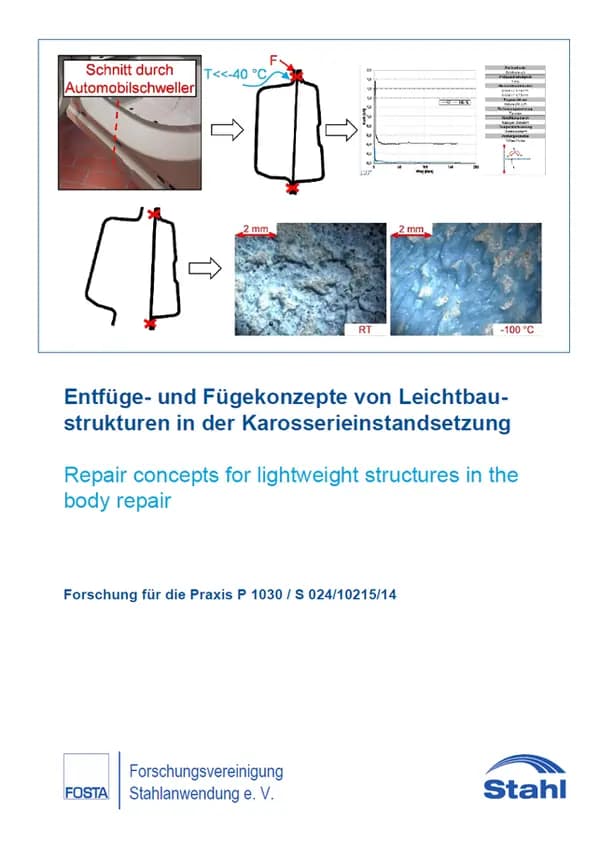
P 1030 - Removal and joining concepts for lightweight structures in car body repair In the course of a vehicle's product life cycle, repairs may become necessary as a result of accidents. The damaged, usually steel-intensive vehicle structures must first be removed in a material-friendly and economical manner. Today's body concepts in particular pose a major challenge for repair shops when it comes to removing the parts. Different steel grades, from soft deep-drawing steels to hot-formed high-strength steels, are used in combination. In addition to spot thermal (resistance spot welding) and mechanical (self-pierce riveting) processes, adhesive bonding is the main joining method used. As part of the project carried out, the state of the art in the field of "debonding and repairing" of automotive joining techniques was analysed and the main challenges derived from this. These are the debonding of adhesive joints in general and in particular in combination with high-strength steels. Currently, an adhesive bond is chiselled or peeled open with great mechanical effort if necessary. This can be carried out with the support of heating, but is often undefined. In newer designs, the use of high-strength steels means that peeling is no longer possible due to the high rigidity of the components. This is where in-depth investigations come in. The work packages were defined using a scientific approach and on the basis of the testing concepts and methods established at the LWF and HSHL. Creative workshops were held in order to identify new solutions for removing joints from high-performance materials based on the current experience of body repair specialists. Thermally assisted debonding proved to be a promising approach for the gentle separation of bonded joints. This includes both high and very low temperatures. It has been shown that cryogenic cooling causes severe embrittlement of the adhesive and that failure occurs without severe deformation of the bonded parts. It was also shown that thermally assisted debonding up to 150 °C has no negative effect on the strength of the remaining bonded joints. Joints repaired in a practical manner after a successful debonding operation exhibited a load-bearing capacity comparable to the series joints. Publication: May 2020 Authors: Prof. Dr.-Ing. G. Meschut, M. Sc. J. Ditter, Dr.-Ing. M. Wünsche, Prof. Dr.-Ing. T. M. Wibbeke
available anytime
€20.00
excl. VAT

P 1032 - Characterisation and modelling of mechanical joints with one-sided accessibility for profile-intensive lightweight construction under crash load The legal regulations to reduce greenhouse gas emissions are prompting the automotive industry to implement consistent lightweight construction. The reduction of CO2 emissions to an average of 95g CO2/km in passenger car traffic by 2020 has been agreed. The vehicle body, which accounts for over 30% of the total weight, offers the greatest potential for implementing lightweight construction, which can be achieved by using high-strength steels in thin sheet thicknesses and other lightweight materials such as aluminium or fibre-reinforced plastics. Due to the profile-intensive mixed construction method, the requirement for accessibility of the joints on both sides cannot be realised throughout the design. Joining technology is increasingly being used for joining tasks that can only be accessed from one side. Methods such as direct screwing (flow-hole moulding screws) and bolt setting are then used here. The aim of the research project is the experimental investigation and numerical modelling of the strength, load-bearing behaviour, deformation and failure behaviour of mechanical joints with one-sided accessibility for profile-intensive lightweight construction under crash load. Using the LWF-KS-2 test technique, characteristic values for the replacement modelling of these connections for crash simulation are to be determined for the joining methods of bolt setting and flow-hole and thread-forming screws (FLS). A substitute model is to be further developed and calibrated for these connections on the basis of the existing substitute model for self-pierce rivet connections. This modelling is to be validated for use in crash simulations using simulations of a sample component test. As part of the research project, tensile tests for a quasi-static and an impact strain rate were carried out for the test materials as an initial test. These form the basis for the subsequent simulation. Following the sampling of the joints planned in this project, characteristic joint values were determined for different set bolt and FLS joints. In order to assess the influence of the position of the joining point in a component and thus the stiffness of the joining parts on the joint behaviour, tests were carried out under shear and peel loading with variation of the specimen geometry. By developing a substitute model and characterisation methodology for joints in profile-intensive lightweight construction, such as flow-hole forming screws and bolting, steel users in design and calculation are able to make reliable statements about the load-bearing capacity of joined steel structures under crash load. This enables the efficient and economical development of joined components made of sten steels for profile-intensive lightweight construction and improves the competitiveness of steel compared to other lightweight construction materials. Publication: 2017 Authors: Dr.-Ing. S. Sommer, Prof. Dr.-Ing. G. Meschut
available anytime
€30.00
excl. VAT

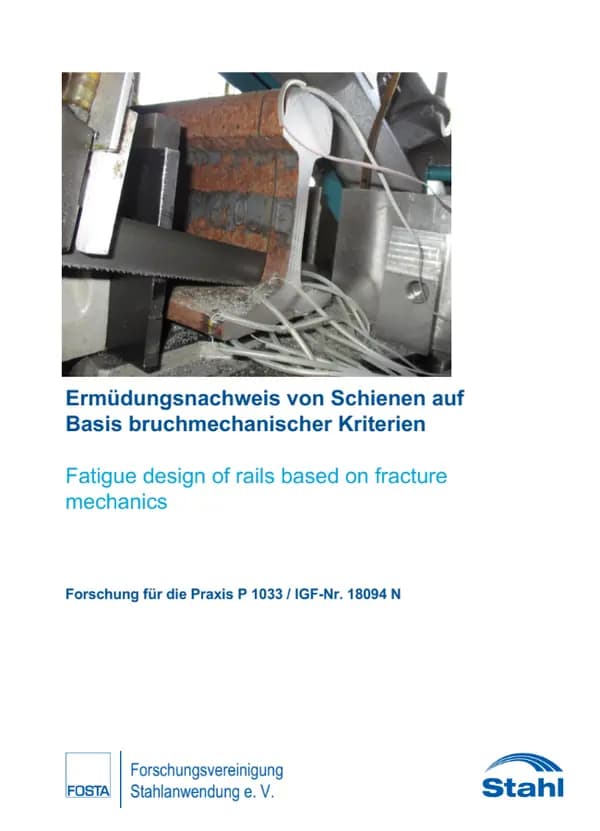
P 1033 - Fatigue analysis of rails based on fracture mechanics criteria In this research project, approaches for the fracture-mechanical description of crack growth in the rail base are developed. For this purpose, finite element simulations are used to show how the stresses from residual stresses, temperature, train passage and structural deformation are distributed in the rail base. The magnitude of the loads to be applied from structural deformation is determined. It can be shown that the stress components can be categorised into three groups according to their distribution in the rail footing, which can subsequently also be found in the determination of the K-factors. Finally, the relationship between torsion and displacement of the bridge head is analysed in more detail. The residual stresses of the rails are determined experimentally. It is shown that the expected residual compressive stresses at the edge of the rail footing also occur in reality. Tensile residual stresses prevail in the centre of the rail base. However, the degree of residual tensile stresses varied greatly depending on the rail grade tested. The large-scale fracture mechanics tests on notched rails show that notched rails of the same quality behave similarly and that fracture mechanics concepts based on cracks in the rail base can therefore in principle describe the cracking of rails. can describe the cracking of rails. However, it is also established that the large-scale tests do not allow any conclusions to be drawn about the actual life expectancy of a railway rail in the track. The notch introduced modifies the test specimens in such a way that the results obtained with them allow conclusions to be drawn about the fracture mechanics model to be used. It is not possible to draw conclusions about the resistance to crack initiation of the individual test specimens. In small-scale fracture mechanics tests, the fracture toughness of the rail steels is determined at the "rail base centre" and "rail base edge" extraction points. It turns out that a purely elastic evaluation of the tests is not expedient. An evaluation for elastic-plastic materials is necessary. It cannot be conclusively clarified whether this necessity is due solely to the material properties of the rail steel or also to the very narrow samples. In order to visualise crack growth using fracture mechanics methods, various approaches are different approaches are shown and the possibility of simulating seasonal dependencies and the interaction of different loads is presented. It is shown that the simulation of individual cracks is very suitable for demonstrating the influence of individual parameters on crack growth. Publication: January 2021 Authors: Prof. Dr.-Ing. M. Mensinger, M.Sc. S. Pessel, Prof. Dr.-Ing. S. Freudenstein, Dr.-Ing. Ch. Simon, Prof. Dr.-Ing. Fischer, M.Sc. N. Schramm, Prof. Dr.-Ing. P. Langenberg
available anytime
€30.00
excl. VAT
Payment by card (Stripe) or invoice (DE, AT, CH). Download link by email: automatically after ordering by card, after order approval for invoice (valid for 30 days). Terms