The design concept contained in the technical regulations for steel construction is aimed at determining the actual load-bearing capacity of components. The underlying load-bearing capacity functions are usually …
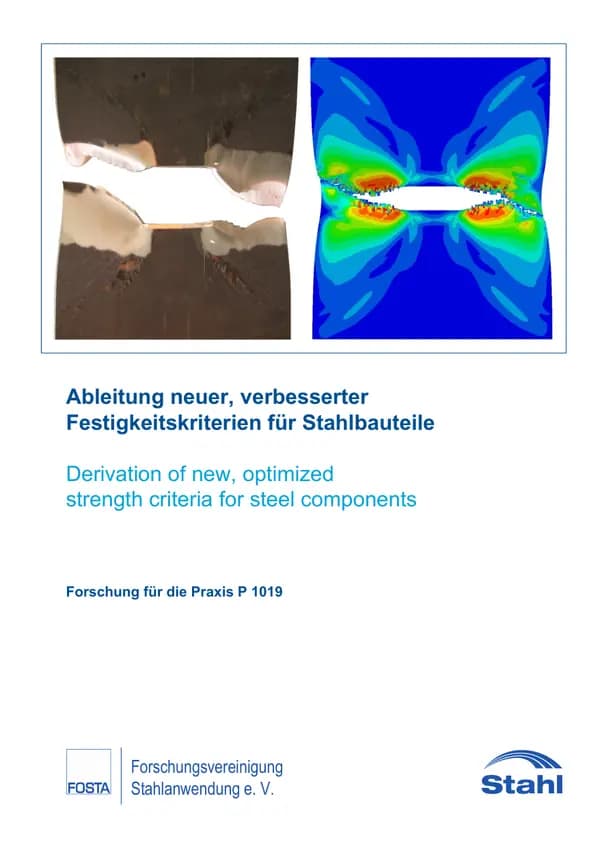
P 1019 - Derivation of new, improved strength criteria for steel components The design concept contained in the technical regulations for steel construction is aimed at determining the actual load-bearing capacity of components. The underlying load-bearing capacity functions are usually calibrated using tests. However, purely phenomenological engineering models are used, which link the limit load prediction approximately to the yield strength or tensile strength of the material. This has two decisive consequences: (1) The prediction accuracies of current strength functions are limited because the underlying model concepts do not take into account the actual failure behaviour of the material.
The current scatter results from the failure to take into account the actual fracture mechanism and the preceding damage history, which are largely dependent on the actual toughness properties. (2) The use of higher-strength steels and the utilisation of their performance characteristics is significantly restricted, as the setting of high yield strengths for high-strength unalloyed structural steels is only possible at the expense of uniform elongation. However, as the regulations prescribe minimum values for uniform elongation and yield strength ratio without taking into account the special failure behaviour of high-strength steels, these steel grades are often unjustifiably excluded from use. However, the use of high-strength steel grades for steel components promises economic and ecological advantages, for example through cost and energy savings with lower material consumption. An improvement in the strength criteria is therefore definitely worth striving for. In similar projects on the use of pressure vessel steels (FOSTA P 758 and FOSTA P 950), new safety factors for the use of high-strength steels in pressure vessel construction were derived by using new strength criteria that take into account the ductility properties of the material. The core of the methodology was a damage-mechanical investigation of the actual failure behaviour by implementing the phenomenological BAI-WIERZBICKI model (BW) as a crack initiation criterion for failure detection. The damage criterion was based on damage location curves derived by means of simulations with the micromechanically motivated damage mechanics model according to GURSON-TVERGAARD-NEEDLEMAN (GTN). However, the procedure used there cannot be easily transferred to design rules for general steel construction. In the present project, the methodology was therefore transferred to steel components and at the same time a comprehensive investigation of the load-bearing behaviour of modern steels was carried out. The experimental investigations enable the analysis of the actual ultimate load and fracture behaviour as well as the comparison with the design rules of EC3. For individual geometries and steel grades, significant safety reserves were identified in some cases. Furthermore, the tests serve to validate the damage model. This showed that the approach is basically suitable for mapping the failure behaviour, but that there are still difficulties in correlating the model parameters with material parameters due to the dependence on the mesh size. FOSTA - Forschungsvereinigung Stahlanwendung e. V. P 1019 / IGF No. 17925 N
Payment by card (Stripe) or invoice (DE, AT, CH). Download link by email: automatically after ordering by card, after order approval for invoice (valid for 30 days). Terms
Machine-translated title and description. The document itself is in German.
Digital download
Other parts and editions as well as neighbouring documents of the same series.

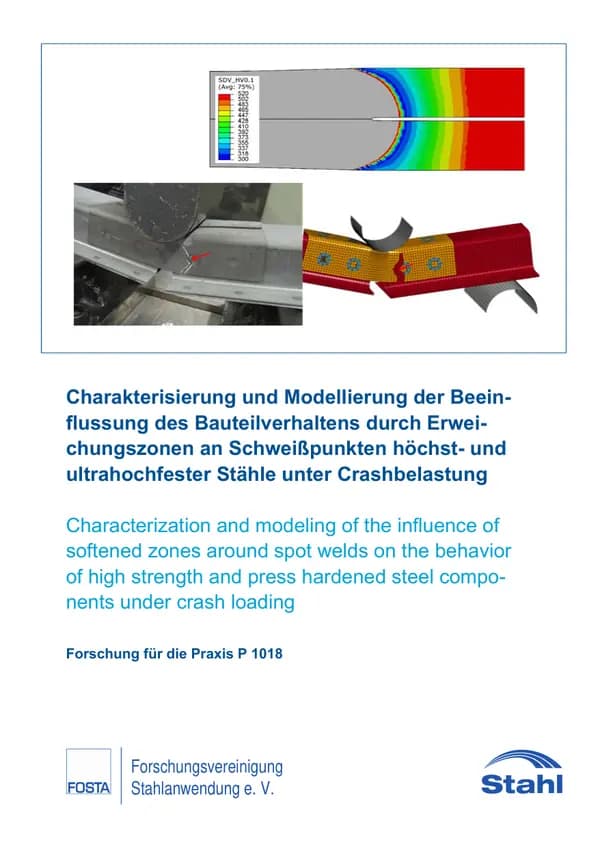
P 1018 - Characterisation and modelling of the influence of softening zones on weld spots of ultra-high and high-strength steels under crash load on component behaviour In automotive engineering, high-strength steels are increasingly being used in thin sheet thicknesses for lightweight construction reasons in order to increase energy efficiency and passive safety while at the same time conserving resources. Currently and in the future, the established and highly automatable resistance spot welding process will be used to join the individual components made from these high-strength steels to form a load-bearing structure. During spot welding, softening zones form in high-strength steels due to tempering effects, which can jeopardise component integrity. The aim of the research project is to establish a generally valid relationship that describes the reduction in the strength of spot-welded high-strength sheets as a function of the geometric dimensions of the softening zone and the strength mismatch of the joint. The influences of the welding parameters on the formation of the softening zone are investigated and experimentally verified by numerical process simulation of spot welding. Spot-welded joints with geometrically different formation of the softening zone are produced and their influence on the mechanical properties of the welded steel sheet is demonstrated. This is investigated on press-hardened 22MnB5 and on complex-phase steel HCT980C. The KS-2 test technique is used to examine the influence of softening zones on the head tension and shear tension load-bearing capacity of the spot welds. With these tests and the characterisation of the softening zone, modelling recommendations for weld spot replacement models for crash simulation are drawn up and validated by simulating the sample component tests and T-impact tests carried out. The hardness measurements in the cross-section of the spot welds in the high-strength steels HCT1180X, HCT980X and HTC980C show all hardness reductions, i.e. softening zones, next to the spot welds. In tensile and puncture tests with samples that contained spot welds with softening zones in the test area, HCT1180X in particular showed the greatest reduction in strength and elongation at break, while the tensile strength of HCT980C and HCT980X was not reduced, but the elongation at break was significantly reduced. If the crack initiation occurs in the softening zone of a weld spot in component tests with bending and superimposed tensile loading, the crack propagates into the base material under further loading. These results are incorporated into a simulation methodology for the evaluation of crack formation in softening zones. This enables steel users in design and calculation to make statements about the load-bearing capacity of spot-welded constructions made of ultra-high-strength and ultra-high-strength steels. This enables the efficient and economical development of spot-welded components made of ultra-high-strength steels and thus contributes to the qualification of these steels for new spot-welded lightweight components. The IGF project 17991 N of FOSTA -Forschungsvereinigung Stahlanwendung e. V., Düsseldorf, was funded by the Federal Ministry for Economic Affairs and Energy via the AiF as part of the programme for the promotion of joint industrial research (IGF) on the basis of a resolution of the German Bundestag. The project was carried out at the Fraunhofer Institute for Mechanics of Materials IWM, Freiburg, at the Laboratory for Materials and Joining Technology (LWF) at the University of Paderborn and at the Materials Testing Institute MPA, Stuttgart. Publication: 2019 Authors: Dr.-Ing. Silke Sommer, Dipl.-Ing. Lilia Schuster, Prof. Dr.-Ing. Gerson Meschut, Dipl.-Ing. Gökhan Tümkaya, Dr.-Ing. David Hein, Prof. Dr.-Ing. Stefan Weihe, Dipl.-Ing. Fabian Schreyer, Dr.-Ing. Ulrich Weber
available anytime
€50.00
excl. VAT

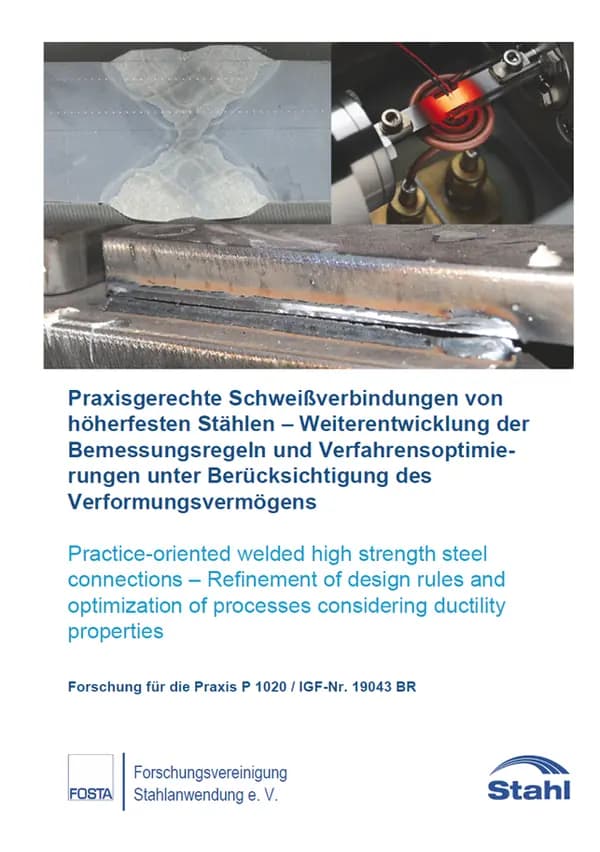
P 1020 - Practice-oriented welded joints of high-strength steels - Further development of the design rules and process optimisation taking into account the deformation capacity Due to various residual reductions in the design and execution of steel and plant structures, the economic use of high-strength structural steels in this area is only possible to a limited extent. The aim of the research project was therefore to create a basis that would lead to a significant improvement in the conditions of use of higher-strength steels in welded joints. The need to improve the technical rules for design and execution arose for a number of other reasons. For example, the permissible weld seam stresses for matching and overmatching joints are defined too conservatively for many joint shapes and combinations of base and filler material. The correlation coefficient βw was defined for the most unfavourable case in which flank fillet welds are subjected to parallel shear. For a large proportion of welded joints, however, it is not necessary for the strength of the base material to be reached or even exceeded. This applies, for example, to neck welds of welded I and box sections, articulated end plate connections, butt joints in areas of low stress and many other cases. To achieve the research objectives, the mechanical properties of weld seams were systematically analysed using a newly developed small-part test. In addition, the influence of welding-induced energy input on the transformation behaviour and mechanical properties of high-strength steels of different manufacturing processes and steel grades was analysed. Knowledge of the influence of the manufacturing parameters makes it possible to specifically address the respective steels and required weld properties by selecting a suitable matching scenario, welding consumables and process parameters. This creates a basis for manufacturing welded constructions from high-strength steels more economically and with greater process reliability. Extensive experimental and numerical investigations were carried out to develop a modern design model. The new design model is based on a systematic separation of the mechanical properties of the weld seam and the design-related requirements placed on it. As part of the investigations, flank fillet welds of lap joints, face fillet welds of cross joints as well as through-welded and non-through-welded butt joints of different welding consumables and production parameters were analysed. By taking into account the actual properties of the weld seams as a function of the filler metal and the cooling time t8/5 as well as the joint shape, more economical weld seam load-bearing capacities can be achieved. A more economical design allows weld seam volumes and, if necessary, sheet thicknesses to be significantly reduced, which leads to an increase in the economic efficiency of welded constructions made of high-strength steels. Publication date: May 2020 Authors: Prof. Dr.-Ing. R. Stroetmann, Dipl.-Ing. T. Kästner, Dipl.-Ing. L. Werner, Dr.-Ing. A. Hälsig, Dipl.-Ing. S. Neyka, Dr.-Ing. M. Kusch, Prof. Dr. P. Mayr
available anytime
€40.00
excl. VAT

P 1016 - Self-pierce riveting of high-strength steel materials in mixed structures using self-clinching self-pierce riveting elements The statutory regulations to reduce greenhouse gas emissions are prompting the automotive industry to implement consistent lightweight construction. The reduction of CO2 emissions to an average of 95g CO2/km in passenger car traffic by 2020 has been decided. The vehicle body, which accounts for over 30% of the total weight, offers the greatest potential for implementing lightweight construction, which can be achieved by using high-strength steels and other lightweight materials such as aluminium. In particular, the mixed construction of press-hardened steel and aluminium in combination with adhesive bonding leads to economical lightweight construction solutions. One suitable technology for joining this combination of materials is full-punch rivet bonding. However, full-punch rivet bonded joints lead to gaps between the parts to be joined and thus to poor adhesive bonding, especially when using particularly thin materials for the parts to be joined. The aim of the research project is to develop a modified self-pierce riveting technology for joining high-strength sheet materials with aluminium alloys. This is achieved by modifying the solid self-pierce riveting process so that it works without an embossing ring on the die-side tool. The embossing contour is positioned directly under the setting head of the rivet. Joints produced using the innovative self-clinching self-pierce riveting process should then be characterised by low joining process-related deformations and good adhesive bonding. As part of the research project, geometry optimisations were carried out using simulation, which were validated by experimental investigations. The flexibility of the newly developed process was then determined on the basis of a process analysis. In addition, the joining properties of the process in combination with adhesives were optimised and the property profile recorded as part of investigations into hybrid joining. A joining process was developed with which it is possible to produce efficient and economical joints from 22MnB5 sheets and aluminium sheets in the thin sheet range. Publication: 2017 Authors: Prof. Dr.-Ing. G. Meschut
available anytime
€30.00
excl. VAT

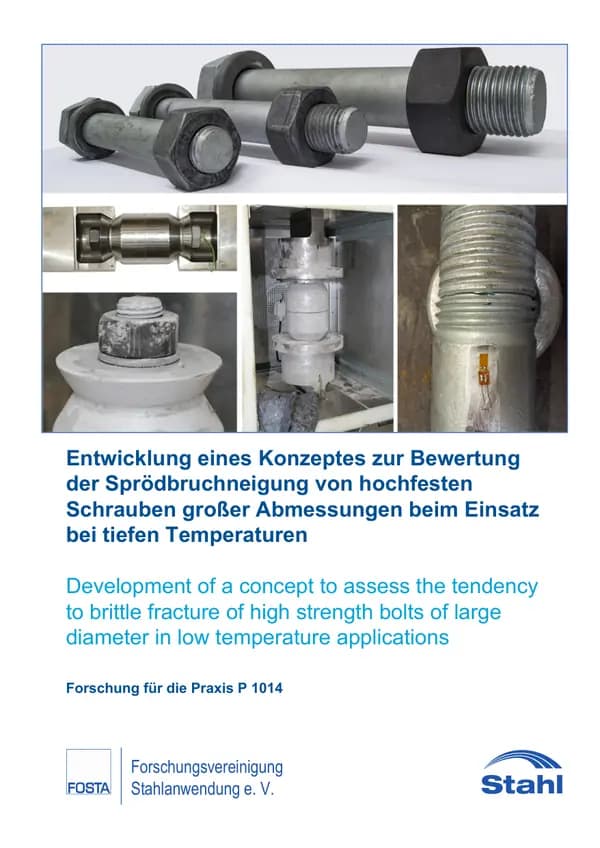
P 1014 - Development of a concept to evaluate the brittle fracture tendency of high-strength bolts of large dimensions when used at low temperatures High-strength HV system bolt assemblies are increasingly being used as prestressed assemblies in large dimensions up to M72 in highly stressed steel structures. In addition to static and cyclical stresses, the connections are also exposed to low temperatures. It is known that the risk of brittle fracture increases with increasing thickness of steel components at low temperatures - in principle, this also applies to larger bolt diameters. In this research project, systematic investigations were carried out into the brittle fracture tendency of high-strength bolts of large dimensions in the diameter range from M24 to M64 at low temperatures. First, the mechanical properties were characterised and the fracture toughness behaviour was described in the form of notched bar impact tests and fracture mechanics tests. The transition temperatures from the notched bar impact test and fracture mechanics test could be correlated with each other using existing correlation approaches. By analysing finite element calculations, it was possible to identify the stress state in the first load-bearing thread as decisive with regard to brittle fracture. In component tests at low temperatures, in which the screws were pre-damaged from a mechanically introduced notch under a fatigue load, it was clearly demonstrated that the screw steels currently used are not at risk of brittle fracture when used at temperatures down to -50 °C. Based on the test results, fracture and damage mechanics calculation models were created in order to define minimum requirements for the material properties to prevent brittle fracture. The damage mechanics model showed very conservative results here, so that it is currently not possible to derive minimum requirements without further development. The fracture mechanics model was able to reproduce the test results, but also delivered conservative results in the derivation of minimum requirements. The fracture mechanics model must be further verified on the basis of a broader database. In the present research project, however, a fundamental evaluation of the brittle fracture tendency of high-strength bolts of large dimensions at low temperatures was carried out. It was shown that the bolt steels currently used are not susceptible to brittle fracture when used at low temperatures. Publication date: April 2019 Authors: Prof. Dr.-Ing. habil. N. Stranghöner, Ch. Lorenz, M.Sc., Prof. Dr.-Ing. M. Feldmann, S. Citarelli, M.Sc., Prof. Dr.-Ing. W. Bleck, Prof. Dr.-Ing. S. Münstermann, Dr.-Ing. Brinnel
available anytime
€40.00
excl. VAT
Payment by card (Stripe) or invoice (DE, AT, CH). Download link by email: automatically after ordering by card, after order approval for invoice (valid for 30 days). Terms